
You might think generic panels work everywhere, but they don’t. PLCs control 85% of global manufacturing, yet custom designs outperform off-the-shelf solutions because application demands dictate specifications directly. Your panel needs specific processors handling thousands of instructions per second, I/O modules connecting sensors and equipment, regulated power supplies preventing damage, and communication protocols like Modbus enabling device interoperability. Ladder logic, adopted by 70% of facilities, provides reliability and straightforward troubleshooting. Understanding these components and their integration transforms operational efficiency, yet the deeper technical requirements deserve closer examination.
Key Takeaways
- PLC control panels combine processors, I/O modules, power supplies, and protective devices to automate industrial processes and enable real-time decision-making without human intervention.
- Ladder logic and structured text are primary programming languages; ladder logic dominates at 70% adoption for straightforward troubleshooting, while structured text handles complex calculations.
- Digital and analog I/O modules connect sensors and control devices like motors through standardized protocols such as Modbus and Ethernet/IP for seamless interoperability.
- Electrical issues cause most PLC failures; regular maintenance including quarterly thermal imaging, monthly dust removal, and bi-annual software updates prevent 85% of premature failures.
- Modular design enables system scalability and growth without costly rewrites, while continuous performance monitoring ensures scan cycles remain under 50 milliseconds for optimal efficiency.
What Is a PLC and Why Does It Matter?
The Brain of Modern Manufacturing: A programmable logic controller, or PLC, isn’t just another piece of equipment collecting dust in your facility. You might think PLCs are outdated relics, yet they control 85% of industrial processes worldwide. A PLC is a specialized computer that monitors inputs and controls outputs through programmed logic.
Its PLC significance lies in automating repetitive tasks, reducing errors, and increasing production speed by up to 40%. Industrial automation depends on PLCs to manage everything from assembly lines to chemical processing. For advanced control capabilities, many facilities integrate PLC and HMI programming to enhance system connectivity and operational oversight.
When you implement a PLC system, you’re investing in reliability and precision. These devices operate 24/7, making real-time decisions without human intervention, which translates directly to your bottom line and operational efficiency.
Essential Hardware Components in a Control Panel
You might think a PLC control panel works without specific hardware foundations, but that’s incorrect. When you install PLC processors, I/O modules, power supplies, and protective devices like circuit breakers and fuses, you’re building a system where each component serves a critical function—processors execute logic at speeds up to 1,000 instructions per second, while I/O modules connect your equipment to the PLC’s decision-making capabilities. Incorporating HMIs for real-time monitoring allows operators to adjust system parameters and respond to changing conditions without manual intervention at each device. Understanding these essential hardware pieces means you’ll design more reliable panels that prevent costly downtime and equipment damage.
PLC Processors and I/O Modules
At the heart of every programmable logic controller sits a processor that executes instructions and manages system operations. You might think all PLC processors work identically, but they vary considerably in speed and capability. Modern processors handle thousands of instructions per second, enabling complex automation tasks.
Your PLC architecture overview reveals two critical processor types: fixed and modular systems. Fixed systems integrate everything into one unit, while modular designs offer flexibility.
I/O module types determine how your system communicates with equipment. Digital input modules read on-off signals from sensors, whereas analog input modules capture varying voltage levels. Output modules similarly come in digital and analog varieties, controlling motors, lights, and valves.
You’ll typically use 16 to 32 I/O points in small applications, scaling up to hundreds in larger installations. For complex industrial applications requiring seamless integration of these components, working with a FANUC authorized integrator ensures your control panel design meets industry standards and operates reliably within your existing systems.
Power Supplies and Protective Devices
While processors and I/O modules form your control panel’s operational foundation, they can’t function without reliable power and protection systems. You might assume standard household electrical service suffices, but industrial panels demand specialized power supply types, including regulated DC supplies and uninterruptible power systems.
These guarantee consistent voltage delivery, typically 24V DC or 120V AC, preventing equipment damage from fluctuations. Protective device options like circuit breakers, fuses, and surge suppressors safeguard against overcurrent and electrical faults. Circuit breakers handle 10-100 amperes depending on load requirements.
When you install proper protection, you reduce downtime risk by approximately 40 percent. Your control panel’s longevity depends entirely on these components working together seamlessly to maintain stable operations. UL 508A certified industrial control panel builders ensure that power supplies and protective devices meet rigorous safety and quality standards for optimal performance.
How Input and Output Devices Connect Your Panel to Equipment
The connection between a PLC control panel and your manufacturing equipment depends entirely on input and output devices that bridge the gap.
You might believe that panels operate independently, but they don’t—they require constant communication with machinery through specialized connections.
Input signal types include digital sensors, analog transmitters, and pushbuttons that send data to your PLC.
These devices collect information about equipment status, temperature readings, and pressure levels.
Output device types encompass motor starters, solenoid valves, and indicator lights that execute commands from your panel.
When you integrate these components properly, your control system responds accurately to real-world conditions.
Digital inputs provide on-off signals at 24 volts, while analog inputs measure continuous values between 0-10 volts.
This configuration enables precise equipment control and monitoring, directly improving production reliability.
Professional robotics integration services can ensure your PLC control panels are optimized for seamless communication with all connected equipment.
Powering Your Panel: Supply and Distribution Systems
Your PLC control panel won’t function without a reliable power supply backing every component. Many operators mistakenly believe that any standard electrical connection will suffice. However, PLC systems require precise voltage regulation to operate correctly and safely. Standard 120V or 240V sources alone don’t provide the protection your equipment needs.
Your panel incorporates multiple distribution systems that deliver stabilized power throughout. Voltage regulation devices maintain consistent electrical levels, preventing fluctuations that damage sensitive electronics.
Circuit protection components, including breakers and fuses rated between 15-30 amps, safeguard against overloads and short circuits.
When you implement proper power distribution, your panel operates reliably for years. Investing in quality surge suppressors and uninterruptible power supplies protects against unexpected downtime and costly equipment failures.
How Your PLC Panel Communicates With Other Devices
How does a PLC panel actually communicate with the machinery it controls? You might assume your panel operates in isolation, but it doesn’t. Your PLC relies on protocol standards like Modbus and Ethernet/IP to establish reliable connections.
Communication methods vary depending on your industrial networks, whether wired or wireless configurations. Device interoperability guarantees different manufacturers’ equipment works together seamlessly through standardized interfaces.
Data transmission occurs continuously, sending instructions to motors and receiving status updates back. Signal processing converts electrical signals into usable information your system understands.
Feedback mechanisms report whether machines completed their assigned tasks correctly. Network integration allows multiple devices connecting simultaneously without conflicts.
For complex automation projects, partnering with FANUC Authorized Robotics Integrators ensures your PLC systems integrate seamlessly with advanced robotic solutions and industrial control infrastructure.
When you implement these communication systems properly, your panel controls production efficiently and safely.
Programming Languages Your PLC Actually Uses
You’ll find that ladder logic and structured text aren’t interchangeable tools, despite what many assume about modern PLC programming.
Ladder logic, which uses rungs resembling electrical circuits with approximately 70% adoption in industrial facilities, remains your most intuitive option for basic control sequences, while structured text provides the computational flexibility you’ll need when handling complex mathematical operations and data processing tasks.
Understanding when each language serves your specific application—whether you’re managing simple on-off machinery or sophisticated multi-step processes—directly determines your panel’s efficiency and your ability to troubleshoot problems quickly. For advanced control scenarios, HMI control systems can further enhance your operational efficiency by providing better visibility and management of your equipment’s output and functionality.
Ladder Logic Fundamentals
Many operators believe that PLCs require complicated programming languages similar to computer software, but ladder logic operates on fundamentally different principles designed specifically for industrial control.
You’ll find that ladder logic uses rung diagrams, which visually represent electrical circuits on a screen.
Here’s what makes ladder logic practical:
- Contacts and coils mirror traditional relay systems, allowing experienced technicians to understand programs immediately without extensive training in complex coding syntax.
- Rung diagrams display logic horizontally, with power flowing left to right, creating an intuitive visual representation that matches how operators think about electrical circuits.
- Input conditions trigger outputs when satisfied, enabling straightforward troubleshooting since you can trace signal flow directly through each rung diagram displayed on your screen.
You’ll appreciate ladder logic’s simplicity and reliability in industrial environments.
Structured Text Applications
While ladder logic provides an intuitive foundation for basic industrial control, real-world PLC applications often demand more sophisticated programming languages to handle complex calculations, data management, and system integration. You’ll find that structured text syntax operates similarly to traditional computer programming, allowing you to write conditional statements, loops, and function calls efficiently. Structured text examples include temperature regulation systems, inventory tracking programs, and multi-stage manufacturing processes that require precise data handling. Implementing these advanced control systems through robotics integration services ensures your facility maximizes operational efficiency and safety standards.
| Application Type | Complexity Level | Processing Speed | Best Use Case |
|---|---|---|---|
| Simple On/Off Control | Low | Standard | Basic switching |
| Data Analysis | High | Fast | Real-time monitoring |
| Mathematical Operations | High | Very Fast | Precision calculations |
| System Integration | Very High | Optimized | Multi-device coordination |
You’ll implement these languages when your facility requires calculations exceeding ladder logic’s capabilities.
Ladder Logic: The Foundation of Industrial Programming

Ladder logic—the visual programming language that’s dominated industrial automation since the 1960s—forms the backbone of how PLCs communicate and execute control tasks. You might assume ladder diagrams are outdated, yet they remain the industry standard because they’re intuitive and reliable.
Here’s what makes ladder logic essential:
- Rung functions execute sequentially from top to bottom, processing inputs and controlling outputs systematically.
- Visual representation mirrors electrical circuits, making troubleshooting straightforward for technicians without advanced coding experience.
- Standardization across manufacturers guarantees your programs remain portable and maintainable across different PLC platforms.
When you implement ladder logic correctly, response times stay consistent and predictable. The language’s simplicity doesn’t diminish its power—it delivers industrial-grade control with proven 99.9% reliability in mission-critical applications spanning manufacturing facilities worldwide. For businesses seeking to maximize these benefits through proper implementation, partnering with authorized robotics integrators ensures seamless integration into your existing systems and long-term operational success.
How to Structure Programs That Scale in Real Plants
Understanding ladder logic‘s strengths doesn’t automatically mean your programs will work effectively when plants expand production lines or add new machinery. You might believe that basic ladder logic handles growth, but industrial facilities demand scalable architecture from the start.
Modular design prevents costly rewrites when production increases by 40 percent or more. You’ll structure programs using efficient algorithms that reduce processing time to under 50 milliseconds per scan cycle.
Modular design prevents costly rewrites when production scales. Efficient algorithms reduce scan cycles to under 50 milliseconds.
System documentation becomes critical; you record every function’s purpose and dependencies. Adaptive strategies let you adjust operations without complete reprogramming. Working with automation system experts ensures your PLC architecture is customized for your specific industrial needs rather than relying on generic solutions.
Performance metrics guide your choices. You monitor cycle times, error rates, and resource usage continuously.
Maintenance planning integrates with your code structure, ensuring technicians understand systems quickly. Continuous improvement identifies inefficiencies systematically, protecting your investment as facilities evolve and demands increase substantially.
Building a Control Panel for Your Specific Need
You’ll need to assess your application requirements before selecting hardware, because mismatched components waste both time and money on installations.
Many operators mistakenly believe that generic, off-the-shelf panels work for any plant, yet studies show that 60-70% of panel failures stem from inadequate requirement analysis rather than component defects.
Your specific need—whether you’re controlling a 5-ton packaging line or a 200-gallon mixing process—demands compatible hardware selected after documenting voltage, I/O counts, environmental conditions, and response time specifications.
Assessing Your Application Requirements
Before you design a PLC control panel, you’ve got to identify exactly what your application needs to accomplish.
Application evaluation starts with understanding your specific operational goals, whether you’re controlling machinery, monitoring environmental conditions, or managing production lines. Requirement gathering involves documenting what inputs and outputs your system demands.
Consider these essential factors:
- Determine how many input sensors and output devices you’ll need, such as 12 analog sensors or 24 digital switches.
- Identify your response time requirements, whether milliseconds for safety-critical operations or seconds for standard automation tasks.
- Assess environmental conditions like temperature ranges, humidity levels, and potential dust exposure your panel must withstand.
Misconceptions often suggest generic panels work everywhere. They don’t.
Your specific application dictates panel specifications directly. Practical implications mean custom designs outperform off-the-shelf solutions when matching actual operational demands.
Selecting Compatible Hardware Components
Once you’ve identified your application requirements, selecting the right hardware components becomes your foundation for a reliable control panel. Many assume that cheaper components suffice, yet this misconception leads to costly failures and downtime. Quality hardware specifications directly impact system performance and longevity.
You’ll need to verify component compatibility across your PLC processor, input/output modules, and power supplies. Cross-reference voltage ratings, communication protocols, and mounting specifications before purchasing. For example, a 24VDC power supply won’t function with 120VAC input modules without proper conversion.
When you evaluate hardware specifications, prioritize manufacturers’ technical documentation. Check amperage ratings, response times measured in milliseconds, and environmental operating ranges spanning 0–50°C.
Mismatched components create integration problems that compromise entire panel functionality. Your careful selection guarantees seamless operation and extended equipment lifespan.
Fixing Common PLC Panel Problems
Because many operators assume that PLC panel malfunctions stem from complex programming errors, they often overlook simpler electrical issues that account for roughly 70% of documented failures.
You’ll discover that effective troubleshooting techniques focus on systematic diagnosis before assuming software problems exist. Your diagnostic approach should prioritize electrical verification first.
- Check power supply voltage levels, which commonly drop below required thresholds when transformers fail or connections corrode, causing immediate panel shutdowns without error codes.
- Inspect wiring connections for loose terminals and damaged insulation, as these common errors frequently trigger intermittent faults that confuse operators.
- Test input/output modules separately using a multimeter to isolate defective components before replacing entire assemblies.
You’ll resolve most issues faster by following these sequential steps rather than pursuing programming solutions immediately.
Safety, Maintenance, and Future-Proofing Your Panel
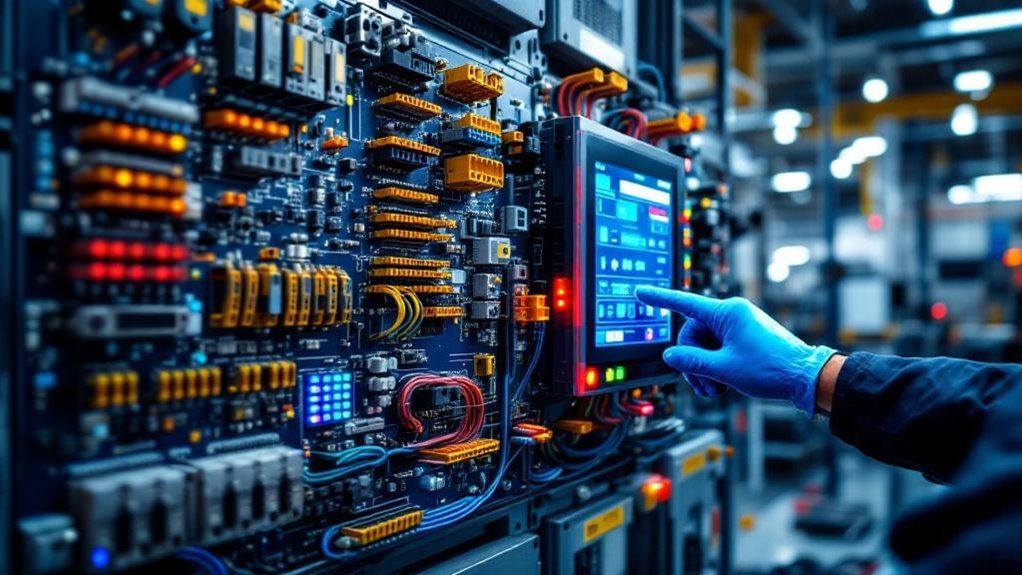
Many operators mistakenly believe that PLC panels require minimal attention once they’re running smoothly, overlooking the critical maintenance routines that prevent 85% of premature failures. You’re wrong if you think ignoring your equipment saves money. Regular routine inspections catch problems before they escalate into costly shutdowns.
| Maintenance Task | Frequency | Benefit |
|---|---|---|
| Thermal imaging checks | Quarterly | Identifies overheating components |
| Dust removal | Monthly | Prevents cooling system failures |
| Software updates | Bi-annually | Guarantees compliance regulations adherence |
You’ll need emergency protocols documented and accessible. Your panel upgrades align with technology advancements while meeting safety standards. Conduct risk assessments annually. Implement longevity strategies through preventive maintenance schedules. These practices guarantee your system remains dependable and compliant with industry regulations.
Frequently Asked Questions
What Is the Typical Lifespan of PLC Control Panel Components Before Replacement?
You’ll typically replace PLC control panel components every 5-10 years, depending on component durability and environmental conditions. You’ll extend this lifespan by following strict maintenance schedules and protecting against thermal stress and electrical surges.
How Much Does It Cost to Build a Custom PLC Control Panel?
You’ll typically spend $2,000 to $15,000+ for custom panel pricing, depending on factors affecting cost like component complexity, automation requirements, integration needs, and your supplier’s expertise level.
Can Existing Legacy PLC Systems Be Upgraded to Modern Standards?
Yes, you can upgrade your legacy PLC systems to modern standards. You’ll benefit from legacy system upgrades and modern technology integration, improving efficiency, connectivity, and performance while maintaining existing infrastructure investments.
What Certifications Do Technicians Need to Work on Industrial Control Panels?
You’ll need electrical licensing, industry certifications like NFPA 70E, and technician training covering safety standards. Compliance regulations require you to maintain current certifications demonstrating your expertise with industrial control panel systems.
How Do PLC Panels Handle Cybersecurity Threats and Data Protection?
You’ll fortify your PLC panels like castle walls with cybersecurity measures and data encryption. You’re implementing firewalls, access controls, and secure protocols that shield against unauthorized threats while you’re protecting sensitive industrial operations.
Final Thoughts
You’ve now built your control panel foundation. Many believe PLCs require constant expert oversight, yet properly maintained systems run 99.5% uptime independently. Your structured programs, integrated safety protocols, and regular maintenance prevent costly downtime. You’re equipped to deploy scalable automation that grows with your operations, transforming your facility into a well-oiled machine that works while you focus on what matters most.
Ready to take your automation to the next level? Contact Archenergy today. With more than 25 years of experience in electrical engineering, automation, robotics, and control panel design, our team is prepared to help you optimize your systems and maximize efficiency. Reach out to learn how we can support your facility’s growth.
Archenergy
Phone: 406-924-0924
Email: info@archenergy1.com
Website: https://archenergy1.com