
Industrial automation integrates robotic systems into your production processes. You might think implementation costs are prohibitive, but pilot programs reduce expenses by 30-40%. Automation handles repetitive tasks with precision while your workforce shifts to supervision and problem-solving. You’ll see labor costs drop 20-30%, production speed increase 40-50%, and defects decline up to 60%. Your industry faces unique challenges that tailored automation solutions directly address.
Key Takeaways
- Industrial automation integrates robotic systems with human expertise to handle repetitive tasks with precision and consistency.
- Automation reduces labor costs by 20-30% and increases production speed by 40-50% while decreasing quality defects by 60%.
- Automated systems achieve defect rate reductions of 50-90%, enhancing customer trust and reducing warranty claims significantly.
- Start small with pilot programs to reduce implementation costs by 30-40% and avoid misconceptions about massive upfront expenses.
- Tailor automation solutions to your industry’s unique challenges—manufacturing, healthcare, logistics, or retail—for maximum operational efficiency.
How Industrial Automation Works
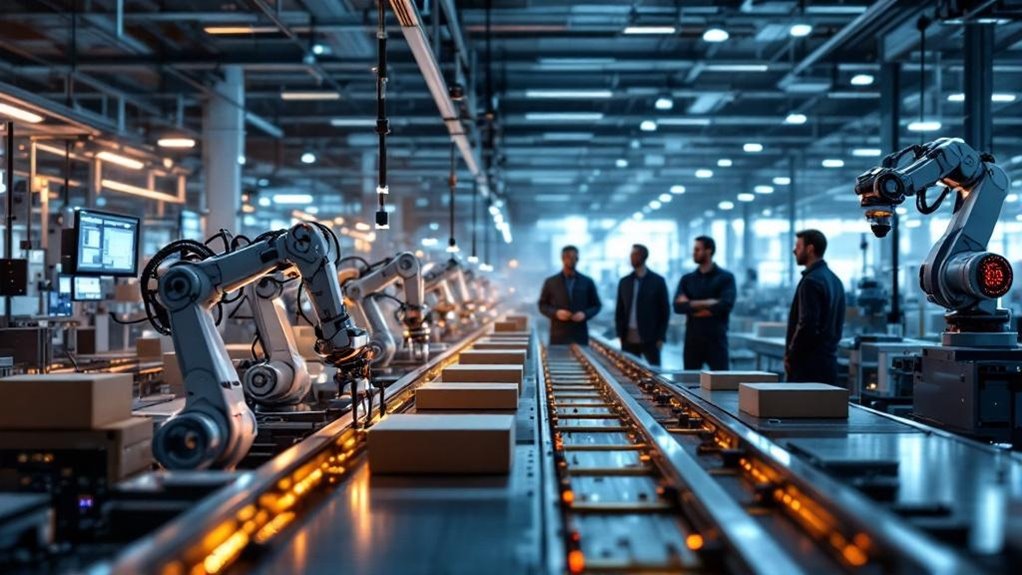
While many people believe industrial automation means replacing all human workers with robots, the reality’s more nuanced and practical. You’ll find that automation integrates robotic systems alongside human expertise rather than eliminating jobs entirely.
These systems handle repetitive tasks like assembly line operations, where precision matters most. Process control technology monitors production variables continuously, adjusting temperature and pressure in manufacturing plants automatically.
Automation handles repetitive assembly tasks with precision while process control technology continuously monitors and adjusts manufacturing variables automatically.
For example, automotive factories use automated welding robots that work 24/7, completing 600 welds daily with 99.9% accuracy. Your workforce shifts roles instead of disappearing. Employees supervise equipment, maintain systems, and solve complex problems.
This combination increases productivity by approximately 35% while reducing errors considerably. Industrial robots can achieve repeatable accuracy of exceptional levels, ensuring consistent quality in production processes. Understanding this distinction helps you recognize automation’s true purpose: enhancing human capability and streamlining operations efficiently.
Why Automation Cuts Costs and Boosts Productivity
Automation’s efficiency gains translate directly into measurable financial advantages that reshape your bottom line.
You’ll discover that your operational expenses decrease dramatically when machines replace manual labor. Cost efficiency emerges through reduced errors, minimized waste, and lower energy consumption per unit produced.
Consider these key improvements:
- Labor costs drop by 20-30% through workforce optimization
- Production speed increases by 40-50% with continuous operation
- Quality defects decrease by up to 60% via precision machinery
- Equipment downtime reduces by 35% through predictive maintenance
Productivity enhancement happens because your systems run 24/7 without fatigue.
Programmable Logic Controllers can be customized to your specific manufacturing processes, ensuring that your automation investment delivers maximum returns tailored to your unique operational needs.
When you implement automation strategically, you’re not simply cutting expenses. You’re fundamentally transforming how your business operates, generating higher output with fewer resources while maintaining consistent quality standards that manual processes can’t match reliably.
How Automation Boosts Quality and Consistency

Because precision machinery operates under strict programmed parameters, you’ll achieve consistency that human workers simply can’t replicate over extended periods. Many believe manual labor maintains comparable quality control standards, but data proves otherwise.
Automated systems reduce defect rates by 50-90% across manufacturing sectors, directly improving your bottom line through fewer returns and rework costs. When you implement automation, consistency improvement becomes measurable and predictable.
Automated systems reduce defect rates by 50-90%, transforming your bottom line through measurable quality improvements and predictable consistency gains.
Robotic arms perform identical movements thousands of times without fatigue, while human operators experience natural performance decline after six hours. Your products meet specifications repeatedly because machines don’t experience off-days or attention lapses.
This reliability strengthens customer trust and reduces warranty claims considerably. You’ll discover that consistent quality builds brand reputation faster than any marketing campaign, creating competitive advantage through operational excellence rather than promotional spending.
Working with a FANUC certified integrator ensures your automation solutions are implemented with precision and reliability, maximizing the quality consistency benefits throughout your production processes.
Automation Solutions by Industry Type
Each industry faces distinct operational challenges that require tailored automation approaches.
You’re mistaken if you think one-size-fits-all solutions work everywhere. Modern automation trends show that specific industry challenges demand customized implementations.
Consider these proven automation solutions:
- Manufacturing: Robotic process automation reduces defects by 30% while increasing throughput.
- Healthcare: Automated scheduling systems cut administrative time by 40%.
- Logistics: Warehouse automation improves order accuracy to 99.9%.
- Retail: Inventory management systems decrease stockouts by 35%.
Your industry’s unique pain points determine which automation tools you’ll need.
When you implement targeted solutions addressing specific industry challenges, you’ll see measurable results.
Current automation trends emphasize customization over generic approaches. Working with FANUC Authorized integrators ensures your robotic systems are designed and installed to meet your specific operational requirements.
You’ll gain competitive advantages by selecting technologies that directly solve your operational bottlenecks rather than adopting trendy solutions that don’t address your actual needs.
Getting Started With Industrial Automation

Many companies believe they’ll need massive upfront investments and complete operational shutdowns to implement automation, but this misconception often prevents them from taking the first step toward modernization.
The misconception of massive upfront costs and complete shutdowns often prevents companies from taking the first step toward automation modernization.
You can start small with pilot programs. Most facilities begin by automating single production lines, reducing implementation costs by 30-40% compared to facility-wide rollouts.
Your technology integration strategy should prioritize existing equipment compatibility first. Start by evaluating current systems and identifying bottlenecks.
Safety standards require proper training before deployment. Invest in employee education programs alongside your automation initiatives. Many companies successfully navigate through phased implementations over 12-24 months.
You’ll experience productivity gains immediately while maintaining operational continuity. Consulting with automation specialists helps you develop realistic timelines and budgets tailored to your specific needs and constraints. Working with UL Certified Control Panel builders ensures your systems meet industry safety standards while optimizing performance.
Frequently Asked Questions
What Are the Initial Costs and ROI Timeline for Industrial Automation Implementation?
You’ll invest $50,000–$500,000+ upfront depending on complexity. Your cost analysis reveals ROI expectations typically range from 2–5 years, with payback accelerating through reduced labor costs and increased productivity gains.
How Do I Choose the Right Automation Vendor or Technology Partner for My Business?
You’ll want to conduct a thorough technology assessment of your operations, then evaluate vendors based on their industry experience, support capabilities, and scalability. You should request references and compare implementation timelines alongside your ROI projections.
What Skills and Training Do Employees Need for Automated Systems?
You don’t need to replace your entire workforce. Your employees need technical skills in system integration, data analysis, and equipment operation. They’ll also benefit from training in troubleshooting, maintenance, and adapting to digital workflows for success.
How Can I Maintain and Troubleshoot Automated Equipment After Installation?
You’ll maintain automated equipment through preventive maintenance schedules, regular inspections, and operator training. For equipment troubleshooting, you’ll document issues, consult manufacturer manuals, and establish relationships with service technicians for complex problems.
What Compliance and Safety Standards Apply to Industrial Automation Systems?
You’re maneuvering a maze of regulatory requirements. Your automation systems must comply with OSHA standards, ISO 12100 safety regulations, and industry-specific compliance requirements that shield your workforce from hazards.
Final Thoughts
Industrial automation delivers powerful results: reduce costs while increasing output, improve quality while enhancing consistency, and strengthen competitiveness while expanding market reach. These benefits aren’t limited to large corporations—they’re achievable for your business right now.
Real numbers prove the impact: 20-30% productivity increases, 15-25% cost reductions, and 99.9% quality rates. Starting small with one process lets you scale confidently forward.
Ready to transform your operations? Contact Archenergy today. With more than 25 years of experience in electrical engineering, automation, robotics, and control panel design, Archenergy has the expertise to guide your business through every step of automation implementation.
Reach out now:
Phone: 406-924-0924
Email: info@archenergy1.com
Website: https://archenergy1.com
Let Archenergy help you unlock measurable returns and competitive advantages through industrial automation.