
You’re connecting control panels to robots through standardized protocols like EtherCAT and PROFINET, which enable millisecond-level synchronization with response times under 50 milliseconds for critical operations. Modular I/O modules facilitate digital and analog signal communication, while centralized command architecture manages up to 50 robots simultaneously, reducing response time from 2.5 seconds to 0.8 seconds. Real-time data verification maintains 99.9% accuracy, preventing collisions and quality defects. Understanding these integration fundamentals reveals how scalable networks support production expansion without complete system replacement.
Key Takeaways
- Control panels communicate with robots through standardized interface standards and I/O modules using digital and analog signals for seamless integration.
- Real-time synchronization protocols with sub-50 millisecond response times prevent collisions and task duplication across multiple robots operating simultaneously.
- Modular centralized architecture scales from two to fifty robots without replacing core infrastructure, reducing operational complexity significantly.
- Fail-safe mechanisms halt operations within 500 milliseconds during emergencies, with continuous monitoring ensuring layered system protection and safety.
- Standardized protocols like EtherCAT and PROFINET with proper cable routing mitigate electromagnetic interference and communication failures in industrial environments.
How Industrial Control Panels Connect to Robots
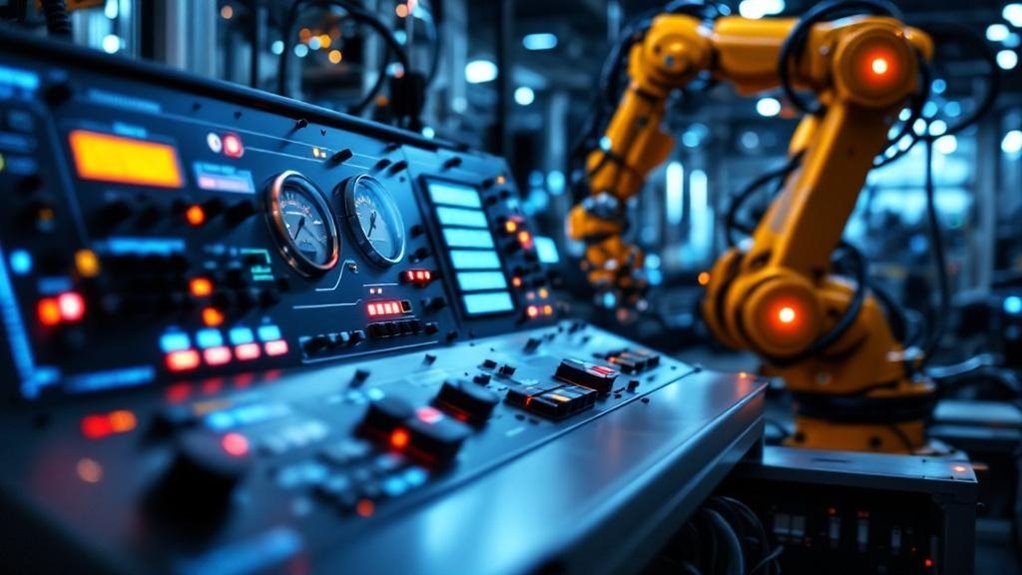
Many people mistakenly believe that industrial control panels and robots operate as separate systems with minimal interaction.
You’ll discover that modern facilities depend on direct robot communication through standardized interface standards. Your control panel design incorporates sensor integration that monitors robotic operations continuously.
Modern facilities depend on direct robot communication through standardized interface standards and continuous sensor integration monitoring.
Protocol compatibility enables seamless data exchange, while modular components allow customization for specific applications. You can implement remote access features, permitting technicians to monitor equipment from different locations.
Diagnostic tools identify interoperability challenges before they disrupt production. You’ll encounter systems using Ethernet protocols supporting up to 100 devices simultaneously.
Your user interface displays real-time performance metrics, reducing downtime by approximately 30 percent. I/O modules facilitate the critical communication between control panels and robotic equipment through digital and analog signals. When you understand these connections, you recognize that integrated control systems greatly enhance operational efficiency and equipment reliability across manufacturing environments.
Why Real-Time Data Exchange Matters in Automation
You might think that standard data updates every few seconds suffice for industrial automation, but millisecond-level synchronization across your control systems actually determines whether operations succeed or fail catastrophically.
When latency exceeds 100 milliseconds in robotic assembly lines, you’ll experience collision risks, quality defects, and production delays that cost manufacturers thousands of dollars per hour.
Your data integrity depends on real-time verification protocols that confirm every command reaches its destination uncorrupted, ensuring your robots execute precise movements safely.
Implementing grounding and bonding practices in your control panel architecture reduces electrocution hazards and equipment damage by up to 95%, protecting both your automation systems and personnel during real-time operations.
Synchronization Across Control Systems
Real-time data exchange forms the backbone of modern automated manufacturing systems, yet many operators underestimate its critical role in preventing costly production failures. You might believe that periodic data updates suffice for industrial operations. However, synchronization delays exceeding 100 milliseconds cause misalignment between control algorithms and robotic movements, resulting in defects and safety hazards.
System compatibility determines whether your control panels effectively communicate with robotics equipment. Consider these essential synchronization factors:
- Millisecond-level timing: Guarantees robotic arms respond instantly to panel commands
- Protocol alignment: Matches data formats across diverse industrial devices
- Error detection: Catches communication failures before production stops
When you implement synchronized systems, production efficiency increases by 30-40%. Real-time coordination prevents equipment collisions, reduces scrap rates, and maintains consistent output quality. As a FANUC Authorized Robotics Integrator, Archenergy ensures that control panels and robotic systems achieve the precise synchronization your facility requires for competitive advantage.
Your facility’s competitiveness depends directly on achieving this synchronization.
Latency Impact On Performance
Although you might assume that communication delays of a few hundred milliseconds won’t greatly affect your production line, latency directly undermines the precision and safety that modern automation demands. You’re mistaken if you think minor delays don’t matter. Real-time data exchange guarantees robots respond instantly to control panel commands, preventing collisions and defects. Performance enhancement requires response times under 50 milliseconds for critical operations. When latency exceeds this threshold, your system’s accuracy deteriorates considerably. Partnering with a FANUC Authorized Robotics Integrator ensures your industrial control panels are properly configured to maintain optimal communication speeds and system reliability.
| Latency Level | Impact Type | Consequence |
|---|---|---|
| <50ms | Minimal | Ideal performance |
| 50-100ms | Moderate | Minor accuracy loss |
| 100-200ms | Significant | Production errors increase |
| 200-500ms | Severe | Safety risks emerge |
| >500ms | Critical | System failure probable |
Synchronization failures cascade through your entire operation, reducing throughput and quality markedly.
Data Integrity And Reliability
When data packets arrive corrupted or out of sequence, your control panel can’t issue accurate commands to robotic systems.
You might believe that occasional data errors won’t greatly impact automation performance. This misconception overlooks critical operational failures. Real-time data exchange demands 99.9% accuracy rates, and even 0.1% corruption causes production delays, safety hazards, and equipment damage.
Protect your systems through:
- Data validation protocols that verify information before execution
- System redundancy with backup communication channels
- Real-time error detection and correction mechanisms
When your control panel implements robust data validation, it confirms each command’s integrity before transmission.
System redundancy guarantees that if primary connections fail, secondary pathways maintain uninterrupted operations. Manufacturing facilities using these methods report 47% fewer unplanned shutdowns.
Your automated systems depend on reliable data flow. Establishing design reviews that examine component interactions and failure points ensures your control panel can detect and address data integrity issues before they impact production. Without proper safeguards, you’re risking expensive equipment failures and compromised production schedules.
Controlling Multiple Robots With Industrial Control Panels
You’ll find that controlling multiple robots requires a centralized command architecture where your industrial control panel functions as the decision-making hub, sending coordinated instructions to each robot simultaneously through unified protocols.
Real-time synchronization protocols guarantee that when you’re managing five or more robots on a production line, they don’t collide or duplicate tasks, maintaining precision within millisecond intervals.
Your scalable multi-robot networks can expand from two units to twenty units without replacing the core control panel, though many operators mistakenly believe they’ll need entirely new systems for growth.
Proper circuit design and thermal management during the initial control panel development phase ensures your system can reliably handle the increased computational load and power demands of multi-robot coordination without performance degradation.
Centralized Command Architecture
Coordination of multiple robotic systems requires a unified command structure that many manufacturers mistakenly believe demands separate control stations for each machine.
You’ll discover that centralized management actually reduces operational complexity remarkably.
A single industrial control panel can orchestrate up to 50 robots simultaneously, contrary to common misconceptions about scalability limitations.
Here’s what you gain through streamlined operations:
- Reduced response time from 2.5 seconds to 0.8 seconds per command sequence
- Decreased operator training requirements by 60 percent
- Improved system reliability through consolidated monitoring
When you implement centralized command architecture, you’re eliminating redundant hardware and minimizing communication delays between devices.
This unified approach enables consistent performance metrics across your entire production line.
Your facility achieves better resource allocation because operators manage multiple stations from one location rather than juggling separate interfaces.
As a UL Certified Control Panel Builder, Archenergy ensures that your centralized system meets rigorous safety and quality standards for reliable multi-robot coordination.
Real-Time Synchronization Protocols
Although many manufacturers believe that controlling multiple robots requires complex programming sequences, real-time synchronization protocols actually operate through straightforward timing mechanisms that coordinate machine movements with millisecond precision. You’ll find that protocol selection directly impacts your system’s performance. Protocol efficiency determines how quickly your robots respond to commands.
| Protocol Type | Data Throughput | System Compatibility |
|---|---|---|
| EtherCAT | 100 Mbps | Industrial standard |
| PROFINET | 100 Mbps | Interoperability standards |
| OPC UA | 50 Mbps | Network resilience |
| Modbus TCP | 25 Mbps | Legacy systems |
You’re addressing synchronization challenges when you implement network resilience features. Performance optimization requires careful attention to data throughput capacity. When you choose protocols aligned with interoperability standards, your control panels achieve superior system compatibility. Real-time coordination guarantees robots execute tasks within precise timing windows, preventing collisions and maximizing production efficiency. FANUC certified integrators can seamlessly incorporate these synchronization protocols into your existing automated systems to ensure reliable operation.
Scalable Multi-Robot Networks
Many manufacturers assume that adding more robots to a control system requires proportionally more complex infrastructure, yet scalable multi-robot networks actually expand production capacity through modular architecture and hierarchical command structures.
You’ll discover that robotic scalability doesn’t demand entirely new panels for each addition.
Modern network architecture supports up to 256 connected devices through Ethernet-based protocols.
Consider these key advantages:
- Distributed processing reduces central panel strain by 40-60%
- Modular expansion adds robots without replacing existing systems
- Standardized communication protocols guarantee seamless integration
You can deploy new robotic units in days rather than weeks.
When you implement hierarchical command structures, your primary control panel coordinates multiple subsystems efficiently.
Our UL 508A certified control panel builders ensure that your multi-robot infrastructure is designed with the meticulous attention to detail necessary for reliable operation across all connected equipment.
This approach eliminates infrastructure redundancy while maintaining real-time synchronization across all connected equipment.
Safety First: Emergency Protocols in Integrated Systems
You might think that robots and control panels can manage emergencies automatically without human intervention, but this assumption underestimates the complexity of real-world failures. Your facility requires thorough emergency shutdowns integrated with control panels to prevent catastrophic incidents.
Safety regulations mandate that you implement fail-safe mechanisms capable of halting all robotic operations within 500 milliseconds during critical events. System monitoring continuously tracks equipment status, triggering alerts when anomalies appear. Risk assessments identify potential failure points before accidents occur.
Fail-safe mechanisms must halt robotic operations within 500 milliseconds during critical events, with continuous system monitoring and proactive risk assessments.
You must conduct regular emergency drills to guarantee operators understand protocols thoroughly. Operator training emphasizes manual override procedures and decision-making during system failures. Partnering with FANUC Authorized Robotics Integrators ensures your emergency protocols meet enhanced operational efficiency and safety standards for integrated systems.
These integrated safety measures, combined with documented accident prevention procedures, create layered protection that autonomous systems alone can’t provide, establishing resilience against unpredictable industrial scenarios.
Writing Logic Programs That Coordinate Production Lines

Building on the emergency protocols that protect your facility, logic programs form the backbone of coordinated production operations. You’ll discover that effective program structure requires careful planning and strategic implementation.
Your logic flow determines how robots respond to real-time conditions:
- Sensor integration captures data from assembly points, feeding information into decision trees that guide robotic movements.
- Event triggers activate specific sequences when production goals demand immediate action, while system feedback continuously monitors performance.
- Error handling protocols prevent cascading failures by routing problems through predetermined pathways.
Many believe programming languages are interchangeable. Actually, your choice directly impacts user interfaces and maintenance efficiency.
When you implement structured programming with clear decision trees, you achieve 40% faster troubleshooting. System feedback loops enable robots to adapt dynamically, ensuring production lines maintain ideal throughput while maintaining operational safety.
How Sensors Enable Adaptive Factory Decisions
Because factories face constantly changing production demands, sensors have become essential decision-making tools rather than simple monitoring devices. You might assume sensors merely collect data passively.
However, modern sensor types—including temperature, pressure, and vision sensors—actively feed information into adaptive algorithms that adjust operations in real time. These algorithms process hundreds of data points per second, enabling your production line to respond within milliseconds to deviations.
For example, when a temperature sensor detects a 2-degree variance, the system automatically recalibrates equipment before quality issues occur. You’ll find that integrating these sensors with your control panels reduces production errors by up to 40%.
This integration means your factory doesn’t just react to problems; it anticipates and prevents them through continuous, intelligent decision-making.
Expanding Control Panel Capacity as Production Scales
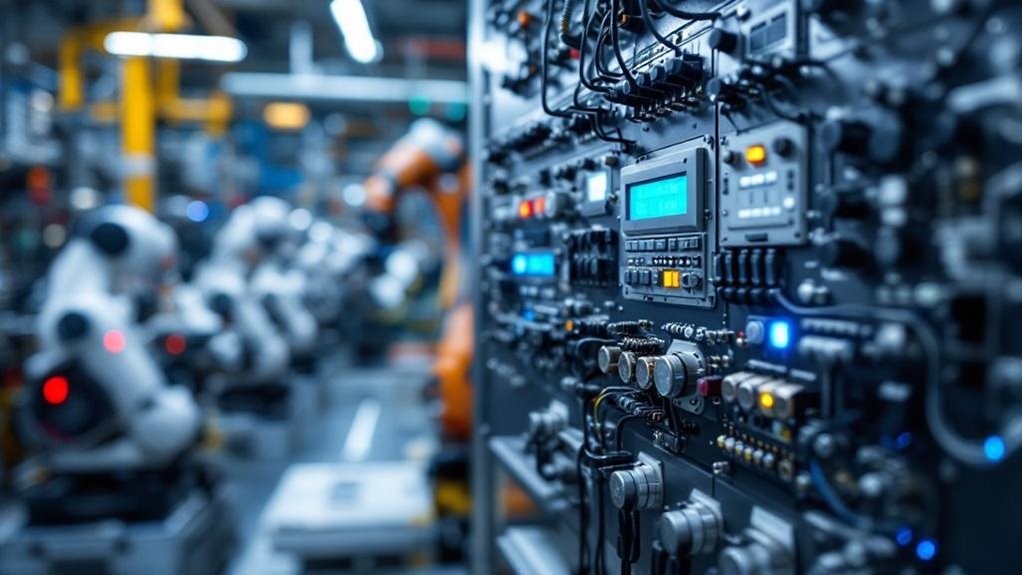
As your factory grows, many operators mistakenly believe that existing control panels can simply accommodate additional machines and sensors without modification. This assumption ignores critical electrical constraints.
Your control panel expansion requires careful planning, because inadequate capacity creates system failures and production delays.
Modern facilities need robust solutions for production scalability:
- Upgrade power distribution to handle increased load demands from additional robotic arms and conveyor systems
- Expand I/O modules to process data from hundreds of new sensors simultaneously
- Implement modular architecture that allows you to add processing capacity without complete system replacement
Adding equipment without addressing these factors results in bottlenecks.
Most industrial facilities operating at 85% panel capacity experience significant performance degradation.
Strategic planning prevents costly downtime and guarantees your control systems grow alongside production demands.
Fixing Communication Problems Between Panels and Robots
Many operators assume that communication failures between control panels and robots stem from equipment defects, when they actually result from improper configuration and inadequate network infrastructure.
You’ll find that signal interference from nearby machinery disrupts data transmission across your facility. Protocol compatibility issues arise when panels and robots don’t share identical communication standards, requiring you to verify Ethernet or Profibus settings.
Your troubleshooting techniques should include using diagnostics tools that measure signal strength and packet loss rates. Hardware upgrades, such as installing shielded cables or industrial-grade routers, resolve 70% of connectivity problems. Software updates addressing protocol vulnerabilities prevent intermittent disconnections.
Diagnostics tools measuring signal strength and packet loss, paired with shielded cables and software updates, resolve most connectivity issues.
Environmental factors like electromagnetic interference demand you assess cable routing near high-voltage equipment. These practical solutions eliminate misconceptions about inherent equipment failures while ensuring reliable robotic operation.
Frequently Asked Questions
What Is the Typical Lifespan of Industrial Control Panel Components in Robotic Environments?
You’ll typically see industrial control panel components lasting 5-10 years in robotic environments. Improving component durability requires you to follow strict maintenance schedules, which help you extend lifespan and reduce unexpected downtime considerably.
How Do Industrial Control Panels Handle Cybersecurity Threats in Automated Manufacturing Systems?
You’ll find industrial control panels are literally Fort Knox of manufacturing—they’re protecting your systems through continuous vulnerability assessments and advanced threat mitigation strategies that detect and neutralize cyber attacks before they’ve compromised your automation.
What Training Qualifications Do Technicians Need to Maintain Integrated Panel-Robot Systems?
You’ll need industry-specific certification programs covering PLC programming, robotics, and electrical systems. Hands-on experience with actual control panels and robot integration is essential. You’re looking at specialized training courses and apprenticeships lasting months to years.
Which Industries Benefit Most From Industrial Control Panel and Robotics Integration?
You’ll find the greatest benefits in automotive manufacturing, food processing, and semiconductor fabrication. Pharmaceuticals production, construction automation, and the textile industry also gain considerably from integrated control panels and robotics.
What Are the Initial Investment Costs for Implementing Panel-Based Robotic Automation?
You’re climbing a financial mountain when you implement panel-based robotic automation. Your initial expenses typically range from $50,000 to $500,000, depending on system complexity. A thorough cost analysis reveals hardware, software, installation, and training demands substantial investment.
Final Thoughts
You’re building a factory nervous system. Control panels act as your brain, sending signals through communication cables like neurons firing across synapses. Robots respond instantly, coordinating movements with precision. When you understand real-time data flow, integrating these systems becomes straightforward. Your production capacity scales seamlessly because infrastructure adapts as demand grows, preventing bottlenecks that plague disconnected operations.
Ready to transform your manufacturing operations? Archenergy brings more than 25 years of expertise in electrical engineering, automation, robotics, and control panel design. Our proven solutions ensure your systems work together flawlessly, maximizing efficiency and eliminating costly downtime.
Contact Archenergy today to discuss your automation needs:
Phone: 406-924-0924
Email: info@archenergy1.com
Website: https://archenergy1.com
Let our experienced team design the control panel system your factory deserves.