
You can’t rely on a single standard when building compliant industrial control panels. UL 508A governs panel construction with specific clearances and NEMA ratings, while NEC Article 409 mandates overcurrent protection that reduces electrical hazards by 95 percent. NFPA 79 takes precedence for industrial machinery, establishing stricter requirements for disconnect switches and arc flash protection. Simultaneous compliance with all three standards prevents inspection failures and extends operational lifespan to 10-20 years, though understanding their overlapping requirements reveals critical safety gaps most technicians miss.
Key Takeaways
- UL 508A mandates specific NEMA ratings, minimum clearances, and construction guidelines to prevent equipment malfunctions and reduce electrical failures by 40 percent.
- NEC Article 409 requires overcurrent protection through circuit breakers or fuses, with proper grounding and bonding reducing electrocution hazards by up to 95 percent.
- NFPA 79 takes precedence over UL and NEC for industrial machinery, establishing stricter requirements for disconnect switches and arc flash protection.
- Forced-air cooling systems maintain component temperatures 15-25°C lower than natural convection, extending equipment lifespan since each 10°C increase reduces electronics lifespan by 50 percent.
- All components must be certified before installation with documented traceability; inspectors reject unmarked devices regardless of functionality, preventing costly rework and ensuring compliance.
Why Industrial Control Panel Standards Exist
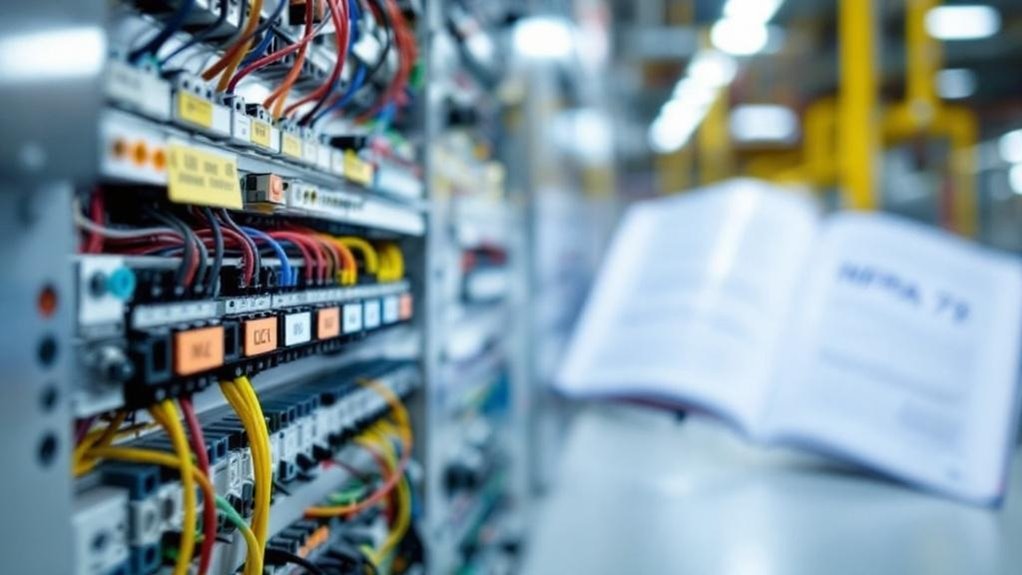
Safety and reliability form the foundation of industrial control panel standards. You might think standards are merely bureaucratic hurdles, but they’re actually critical safeguards. Standards like UL 508A establish compliance benefits by ensuring your equipment won’t malfunction unexpectedly or cause fires.
When you follow NFPA 79 guidelines, you’re implementing safety assurance measures that protect workers and equipment simultaneously. Consider this: panels meeting proper standards reduce electrical failures by approximately 40 percent.
Without standardized requirements, you’d face unpredictable equipment performance and serious workplace hazards. Standards also streamline your maintenance processes because technicians understand consistent designs.
UL 508A: The Standard for Panel Construction
You might assume that any metal box can house your industrial control components, but UL 508A requires you to select enclosures meeting specific NEMA ratings—typically NEMA 1 for general indoor use or NEMA 4X for corrosive environments—ensuring adequate protection against dust, moisture, and mechanical damage.
When you arrange your components inside the panel, you’ll follow spacing requirements that demand minimum clearances of 0.5 inches between live parts and 1 inch from enclosure walls, preventing dangerous arcing and allowing proper heat dissipation that protects your equipment from thermal failure.
These enclosure and spacing standards aren’t arbitrary guidelines; they’re engineering specifications that directly reduce electrical hazards and extend your panel’s operational lifespan from typical 10-year equipment life to potential 15-20 year durability. Archenergy’s UL Certified Control Panel Builder status ensures that your panels meet these rigorous standards and comply with all safety requirements.
Enclosure Selection And Protection
The physical housing of an industrial control panel—its enclosure—serves as the foundation for protecting expensive electrical components from environmental damage and operator contact hazards.
You might assume standard metal boxes suffice for all applications, but enclosure materials and environmental ratings demand careful selection. Steel, stainless steel, and polycarbonate each offer distinct advantages depending on your facility’s conditions.
You’ll want NEMA or IP rating alignment with your specific environment, whether humid, corrosive, or explosive. Accessibility design and maintenance access shouldn’t compromise thermal insulation or corrosion resistance.
Installation guidelines require proper ventilation clearances, typically 12 inches minimum, preventing heat buildup. While aesthetic considerations matter less than protection, they influence operator acceptance.
Your enclosure choice directly impacts component lifespan and system reliability, making informed selection essential to operational success.
Component Arrangement And Spacing
While you might believe that cramming components densely into your control panel saves space and money, UL 508A standards establish precise arrangement and spacing requirements that directly affect safety, functionality, and longevity. Your component layout must follow strict spacing guidelines to prevent electrical hazards and thermal damage.
| Spacing Type | Minimum Distance | Purpose |
|---|---|---|
| Component to Wall | 1 inch | Heat dissipation |
| Wire Bundle Separation | 0.5 inches | Airflow circulation |
| Terminal Block Distance | 2 inches | Maintenance access |
You can’t ignore these requirements without risking equipment failure. Proper spacing allows adequate cooling and simplifies troubleshooting when problems arise. UL 508A mandates that you arrange components logically, grouping related circuits while maintaining clearances. This disciplined approach guarantees your panel operates reliably and meets all regulatory compliance standards effectively. A UL 508A certified control panel builder understands that meticulous attention to detail in component arrangement directly enhances automation, efficiency, and operational integrity across all industrial applications.
NEC Article 409: Core Safety Rules
You’ll find that NEC Article 409 establishes the mandatory overcurrent protection requirements that you must implement in every industrial control panel, typically requiring circuit breakers or fuses rated between 15 and 100 amperes depending on your specific load calculations and conductor sizes.
Many installers mistakenly believe grounding and bonding are interchangeable terms, but you’re actually performing two distinct functions: grounding connects your equipment to earth at 25 ohms or less resistance, while bonding creates low-impedance paths between metal components to prevent voltage differences during faults.
When you properly execute both practices together, you’re directly reducing electrocution hazards and equipment damage by up to 95 percent, which is why inspectors require documented continuity testing on every bonded connection you install.
Overcurrent Protection Requirements
Because electrical fires and equipment damage stem from uncontrolled current flow, NEC Article 409 establishes mandatory overcurrent protection standards for industrial control panels. You must install overcurrent devices rated for your specific circuit amperage and voltage requirements.
Many assume that one protective device suits all applications, but this misconception creates serious safety gaps. Each circuit requires individual circuit protection sized according to NEC Table 430.52, which specifies protection percentages based on motor type and horsepower.
You’ll find that properly sized fuses or circuit breakers prevent thermal damage, arc faults, and catastrophic failures. When you implement coordinated protection schemes across multiple panels, you guarantee selective coordination that isolates faults without disrupting unaffected circuits.
This coordinated approach protects personnel, equipment, and facility operations.
Grounding And Bonding Essentials
Overcurrent protection stops excessive current, yet it won’t protect you if electricity finds an unintended path to ground through personnel or equipment. You might believe grounding simply means connecting wires to earth, but this misconception overlooks critical safety distinctions. Proper grounding techniques involve establishing low-resistance pathways that safely redirect fault currents away from people and machinery.
| Grounding Method | Resistance Target | Application | Safety Benefit |
|---|---|---|---|
| Rod electrodes | <25 ohms | Facility grounds | Fault current dissipation |
| Bonding straps | <0.1 ohms | Equipment interconnection | Equipment voltage equalization |
| Copper conductors | Sized per NEC | Panel enclosures | Personnel shock protection |
| Equipment grounding | <1 ohm loop | Motor frames | Machinery protection |
Bonding methods create equipotential surfaces where you eliminate dangerous voltage differences. When you implement these practices correctly, you substantially reduce electrocution risks and equipment damage throughout your industrial control systems.
NFPA 79: When It Overrides UL and NEC
Many electricians mistakenly believe that UL standards and the National Electrical Code always take precedence in industrial control panel design, but this assumption doesn’t account for NFPA 79‘s authority in specific applications.
NFPA 79 establishes the Standard for Electrical Equipment of Industrial Machinery, and you’ll find its requirements override both UL and NEC guidelines when machinery-specific safety matters arise. Your panels must comply with NFPA relevance standards whenever industrial machinery control systems are involved, particularly regarding control circuit protection and component spacing requirements.
UL compliance remains essential, yet NFPA 79 demands stricter specifications for disconnect switches and arc flash protection in manufacturing environments.
You should recognize that NFPA 79 supersedes general electrical codes because it addresses specialized machinery hazards. This hierarchy guarantees your industrial panels meet machinery-specific safety demands that broader standards simply don’t cover adequately.
How These Standards Work Together
While NFPA 79 holds authority over machinery-specific requirements, it doesn’t eliminate the need for UL and NEC compliance in your industrial control panels.
You might assume these standards conflict, but they actually complement each other through standard interdependencies. Here’s how they work together:
- NFPA 79 provides machinery-focused electrical safety guidelines that reference UL and NEC standards.
- UL 508A certification guarantees your panel components meet product safety requirements.
- NEC Article 409 establishes general control panel installation rules across all applications.
- NFPA 79 adds machinery-specific demands that UL and NEC don’t fully address.
- This layered approach creates approximately 40% fewer compliance challenges when properly implemented.
Your compliance strategy requires addressing all three standards simultaneously.
When you neglect any single standard, you create gaps that regulatory inspectors identify during facility audits.
Following this integrated approach protects your operations effectively.
Control Panel Design: Your Step-by-Step Workflow
Design methodology—the backbone of compliant industrial control panels—requires systematic planning before you install a single component.
You’ll start by documenting electrical requirements, then mapping circuit layouts against NEC and NFPA 79 standards. Many believe panel aesthetics don’t matter; however, organized wiring and clear labeling directly improve maintenance efficiency and reduce safety incidents by up to 40%.
Next, you’ll select components—contactors, breakers, terminals—guaranteeing each meets UL certification requirements. You must monitor regulatory updates continuously since codes change every three years.
Finally, you’ll implement your design through structured assembly, verifying every connection against your documented specifications. This systematic approach prevents costly rework, guarantees compliance, and establishes panels that function reliably throughout their operational lifetime.
Overcurrent Protection and Disconnects: Non-Negotiable Elements
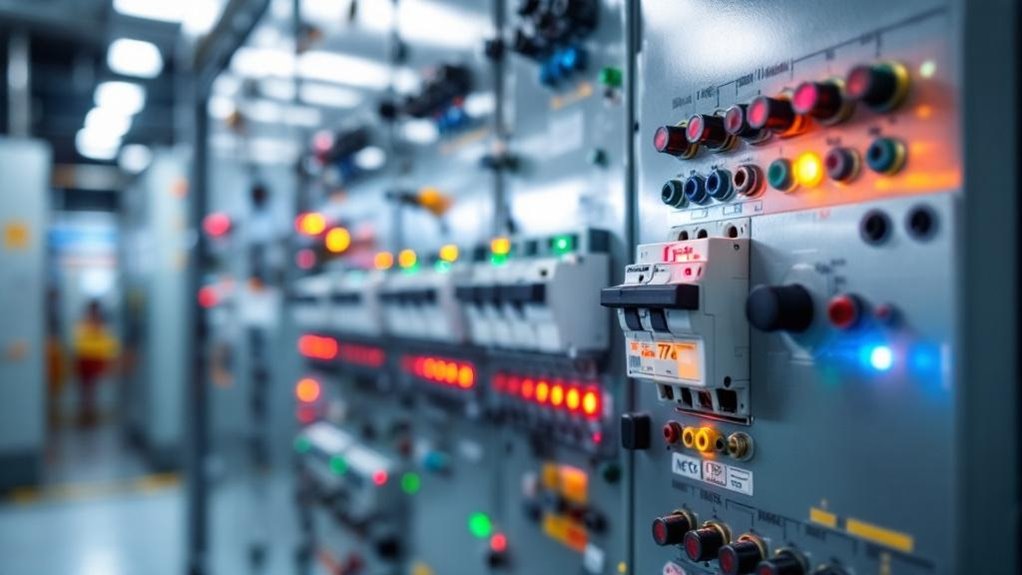
At the core of every compliant industrial control panel sits overcurrent protection—a system you can’t compromise on without risking equipment damage and personnel safety.
You might believe standard fuses suffice for all applications. That’s incorrect. Modern panels require coordinated protection strategies combining multiple devices. Overcurrent testing validates your system’s response under fault conditions, ensuring breakers and fuses operate within specified timeframes.
Essential protection components include:
- Circuit breakers rated for your panel’s voltage and amperage
- Fuses selected for equipment-specific requirements
- Disconnect switches positioned for safe maintenance access
- Thermal-magnetic devices preventing nuisance trips
- Coordination studies confirming proper selectivity
Disconnect selection demands careful attention. You’ll choose between fusible and non-fusible disconnects based on load characteristics and maintenance protocols.
NEC Article 430 mandates disconnects within sight of motors. Your panels must meet these requirements without exception, protecting both equipment longevity and worker safety during emergency situations.
Heat Dissipation: Fan-Cooled vs. Natural Convection
You might think natural convection alone suffices for most industrial panels, but thermal analysis shows forced-air systems maintain component temperatures 15-25°C lower under sustained operation, directly extending equipment lifespan and reliability.
When you’re managing multiple drives, transformers, and contactors in confined spaces, natural convection efficiency drops considerably—often failing to dissipate heat adequately when ambient temperatures exceed 35°C or when components operate continuously at rated capacity.
Your choice between fan-cooled and passive systems ultimately depends on duty cycle, component density, and ambient conditions, since oversizing fans increases energy consumption and maintenance while undersizing them risks thermal runaway that can damage sensitive electronics. Effective thermal management becomes especially critical in automation projects where equipment operates continuously at high capacity, as demonstrated by manufacturing facilities that have upgraded cooling systems alongside their process improvements.
Fan-Cooled System Performance
Many assume natural convection adequately cools industrial control panels in all operating environments, but this misconception overlooks critical performance limitations.
When you install fan-cooled systems, you’re making a strategic investment in superior heat dissipation that natural convection simply can’t match.
Fan-cooled systems deliver measurable advantages:
- Fan efficiency reaches 85-95%, actively pushing hot air away from critical components
- Heat distribution becomes uniform, preventing thermal hotspots that exceed component ratings
- Airflow management allows you to direct cooling precisely where needed most
- System reliability improves dramatically, reducing component failure rates by up to 40%
- Noise reduction through variable-speed fans minimizes operational disruption
You’ll discover that maintenance considerations become straightforward with regular filter changes. As a UL 508A Certified Control Panel Builder, Archenergy ensures that cooling systems meet stringent safety and performance standards while optimizing heat dissipation.
When ambient temperatures exceed 104°F or component density is high, fan-cooled solutions prove indispensable for maintaining peak performance and longevity.
Natural Convection Efficiency Limits
Natural convection systems rely on passive airflow created when warm air rises naturally from heated components, but they can’t match the cooling capacity that forced-air systems provide.
You might think natural convection handles unlimited heat dissipation, yet reality proves different. Most natural convection enclosures max out around 500-800 watts before temperatures exceed safe limits.
Your thermal management strategy must account for this constraint. When ambient temperatures reach 40°C, natural convection efficiency drops considerably because the temperature differential decreases.
You’ll find that panels exceeding 1000 watts require active cooling solutions. Natural convection works best in controlled environments with consistent airflow and moderate ambient temperatures.
For industrial applications requiring customized thermal solutions, proprietary PLC systems can be designed to optimize heat management specific to your facility’s needs.
Understanding these limits prevents costly equipment failures and guarantees reliable industrial control panel operation within standard compliance requirements.
Component Temperature Management Trade-offs
Selecting between fan-cooled and natural convection systems requires understanding how each method handles heat differently under real operating conditions.
You might believe natural convection always costs less, but this misconception ignores thermal management complexities and overheating risks in confined spaces.
Consider these critical trade-offs:
- Space constraints: Fan systems need clearance; natural convection requires larger enclosures
- Energy consumption: Fans use 50-200 watts continuously versus minimal natural convection costs
- Component lifespan: Each 10°C temperature increase reduces electronics life by 50 percent
- Installation flexibility: Fans allow compact designs; natural convection demands strategic positioning
- Maintenance requirements: Fans need cleaning; natural convection requires passive airflow paths
When you choose fan cooling, you’re trading higher energy costs for compact designs and better thermal management.
Natural convection works well in larger enclosures with moderate heat loads below 500 watts. Your decision depends on your specific space, budget, and overheating risk tolerance.
Cable Sizing, Routing, and Identification
Proper cable management is fundamental to industrial control panel reliability and safety. You’ll find that many operators mistakenly believe undersized cables won’t cause problems, yet they generate excessive heat and create fire hazards. NEC standards require you to calculate amperage loads accurately, then select cables with appropriate gauges for your specific applications.
| Identification Method | Voltage Rating | Common Applications |
|---|---|---|
| Color-coded sleeves | 600V maximum | Motor control circuits |
| Printed labels | All voltages | Signal and data lines |
| Heat-shrink tubing | 1000V maximum | High-density panels |
You must route cables away from heat sources and sharp edges. When you bundle conductors together, maintain proper spacing to prevent insulation degradation. NFPA 79 requires clear labeling at both endpoints, ensuring technicians quickly identify circuits during maintenance and troubleshooting procedures without confusion or delays. Working with UL 508A certified panel builders ensures your industrial control systems meet the highest safety and reliability standards throughout their operational lifecycle.
Choosing Approved Components That Pass Inspection
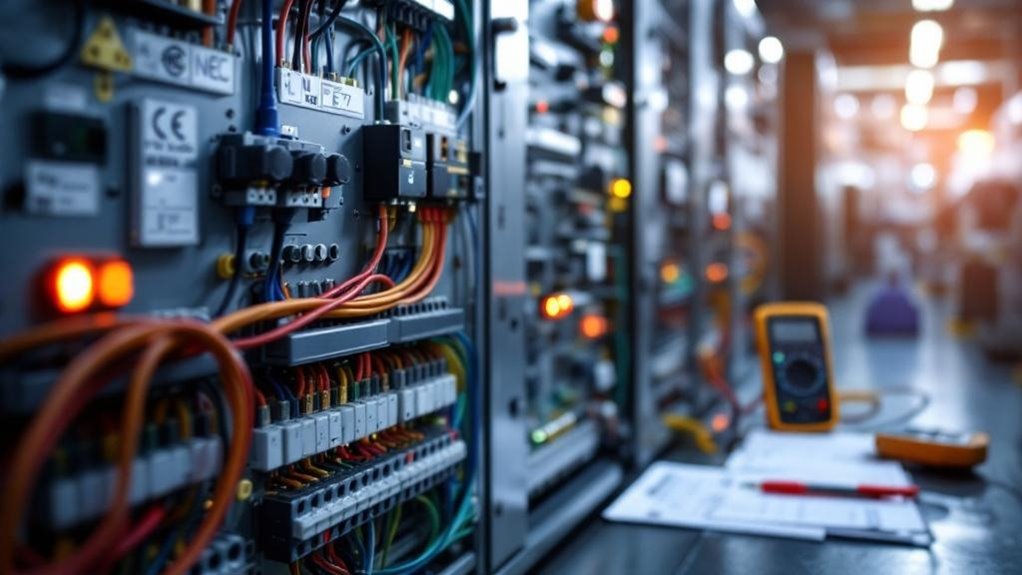
Because many technicians assume that any component meeting basic electrical ratings will pass inspection, they’ve overlooked the critical certification requirements that distinguish approved equipment from non-compliant alternatives.
You must confirm component certification before installation. Inspectors won’t accept unmarked devices regardless of functionality.
Confirm component certification before installation. Inspectors won’t accept unmarked devices regardless of functionality.
You’ll need to source from approved suppliers who maintain UL, CSA, or NFPA 79 listings. Here’s what guarantees compliance:
- Verify UL certification marks on all components
- Purchase from distributors maintaining current certifications
- Cross-reference part numbers against approved manufacturer databases
- Document component traceability for inspection records
- Request certification documentation before purchasing
Non-certified components create liability. You’re responsible for panel compliance.
Approved suppliers provide certificates proving compliance with required standards. This documentation becomes essential during inspections. You’ll avoid costly rework by prioritizing certified equipment from the start.
Frequently Asked Questions
What Are the Differences Between UL 508A Certification and Third-Party Inspection Requirements?
You’ll find that UL 508A Overview establishes manufacturer certification requirements, while third-party inspection demands independent verification. The Certification Process lets you self-certify compliance, whereas inspections require external auditors validating your control panel standards adherence.
How Often Should Industrial Control Panels Be Inspected and Recertified After Installation?
Can you afford downtime from unexpected panel failures? You’ll need annual inspections aligned with your maintenance schedules and inspection frequency requirements, though your specific industry’s regulations may demand more frequent recertification intervals.
Are There Specific Warranty Implications When Panels Don’t Fully Comply With All Standards?
You’ll likely face reduced warranty coverage when your panels don’t fully comply with standards. Manufacturers won’t honor claims if you’ve ignored compliance requirements, creating significant liability and compliance clarity issues for your operations.
What Penalties or Liability Issues Arise From Non-Compliant Panel Installations in Facilities?
You’ll face significant penalty consequences including fines, facility shutdowns, and legal action. Liability risks expose you to worker injury claims, property damage lawsuits, and regulatory citations that’ll damage your operational and financial standing.
How Do International Standards Like IEC 61439 Compare to UL, NEC, and NFPA?
You’ll find IEC 61439 emphasizes international adoption through performance-based standards, while UL, NEC, and NFPA 79 focus on prescriptive requirements. Your IEC comparisons reveal broader global harmonization efforts than North American-specific codes.
Final Thoughts
Standards like UL 508A, NEC Article 409, and NFPA 79 aren’t arbitrary restrictions—they’re your blueprint for safety. Following these standards together protects equipment and personnel. Proper overcurrent protection, correct cable sizing, and approved components reduce failure rates by up to 85%.
Compliance is smart engineering. Your panels will pass inspection and operate reliably.
Don’t navigate these complex requirements alone. Archenergy brings more than 25 years of experience in electrical engineering, automation, robotics, and control panel design. Our team ensures your industrial control panels meet all standards while optimizing performance and reliability.
Contact Archenergy today to build panels that work right the first time:
Phone: 406-924-0924
Email: info@archenergy1.com
Website: https://archenergy1.com
Let our expertise guide your compliance and design strategy.