
You might assume standard panels cost less overall, but that’s incomplete reasoning. Standard panels save 40-60% upfront yet incur $5,000-$15,000 annually in maintenance, while custom panels reduce unplanned downtime by 40-60% and extend lifespan five to ten years. Standard panels deliver 99.2% uptime with familiar configurations; custom panels optimize layouts for 15-25% efficiency gains and integrate seamlessly with your existing equipment. Your choice depends on operational demands, budget constraints, and growth plans—factors that reveal themselves through deeper investigation.
Key Takeaways
- Standard panels offer 40-60% cost savings with quick installation, while custom panels provide 15-25% efficiency gains through optimized design.
- Custom panels reduce response times by 40-60% and unplanned downtime by 40-60%, extending lifespan by 5-10 years.
- Standard panels feature pre-certified components and familiar configurations requiring minimal training; custom panels require individual compliance verification.
- Custom panels include modular design reducing maintenance costs by 30-40% and integrate with 85% of legacy equipment seamlessly.
- Standard panels deliver proven reliability with 99.2% uptime in stable conditions; custom panels eliminate incompatibility issues with existing systems.
Standard Industrial Control Panels: Plug-and-Play Solutions

Many manufacturers believe that standard industrial control panels require extensive customization and specialized technical expertise to install. This misconception couldn’t be further from the truth.
You’ll discover that plug and play advantages eliminate installation complexity through universal compatibility across most industrial environments. Standard panels arrive ready for deployment, reducing setup time from weeks to days.
Installation simplicity means your team connects components without advanced training. Design uniformity guarantees predictable performance across multiple facilities, while maintenance ease allows routine checks without specialized technicians.
Cost effectiveness becomes apparent when you compare standard panels against custom alternatives, typically saving 40-60% in initial expenses. Because these panels follow established industry protocols, you’re protected by proven reliability and widespread support networks.
Standard panels incorporate UL 508A certified components selected for compatibility and compliance, ensuring your equipment meets current safety and regulatory standards from day one. Your operation benefits from reduced downtime and faster troubleshooting procedures.
Custom Industrial Control Panels: Built For Your Facility
You might think standard panels meet every facility’s needs, but custom industrial control panels deliver tailored designs that align precisely with your unique operational requirements and equipment specifications.
When you build panels customized to your exact workflow, you’ll see efficiency gains ranging from 15-25% through optimized layouts, reduced downtime during integration, and streamlined troubleshooting processes.
Your facility’s specific production demands—whether handling variable voltage systems, specialized automation sequences, or complex safety protocols—require purpose-built solutions that generic panels simply can’t provide.
Our UL 508A certified control panel builders prioritize meticulous attention to detail and craftsmanship to ensure your panels are designed for simplicity, neatness, and future expansion needs.
Tailored Design And Specifications
Because every manufacturing environment presents unique operational demands, off-the-shelf control panels often fall short of meeting your facility’s specific requirements. You’ll find that tailored features address your exact operational needs directly.
Custom panels incorporate specific configurations designed around your equipment and processes. Here’s what you gain:
- Precise voltage and amperage ratings matched to your machinery specifications
- Strategic component placement that reduces installation time by up to 40%
- Integrated safety systems tailored to your industry’s regulatory requirements
When you choose customization, you’re eliminating incompatibility issues that standard panels create. Your facility’s unique workflow demands specialized solutions that work seamlessly with existing systems.
Custom designs guarantee peak performance while meeting your budget constraints and timeline requirements effectively. Proper design validation prevents costly downtime and reduces warranty claims by ensuring your panel functions reliably under real-world conditions.
Enhanced Operational Efficiency Gains
When custom control panels align with your facility’s exact specifications, operational downtime drops considerably compared to standard alternatives. You might assume that standard panels offer sufficient efficiency, but they don’t account for your unique operational strategies and workflow demands.
Custom panels reduce response times by 40-60% because they’re engineered specifically for your equipment integration. When you implement tailored solutions, efficiency metrics improve dramatically through streamlined processes and reduced manual interventions.
Standard panels require extensive reconfiguration, creating delays that compound over time. Your facility’s specialized needs demand precision-built systems that eliminate unnecessary steps.
Custom control panels deliver measurable performance gains by eliminating incompatibility issues. You’ll experience faster troubleshooting, improved system reliability, and optimized energy consumption that directly impacts your bottom line through sustained operational excellence. Regular maintenance routines prevent 85% of premature failures, ensuring your custom systems maintain peak performance over their operational lifespan.
Cost Comparison: Initial Investment and Long-Term Value
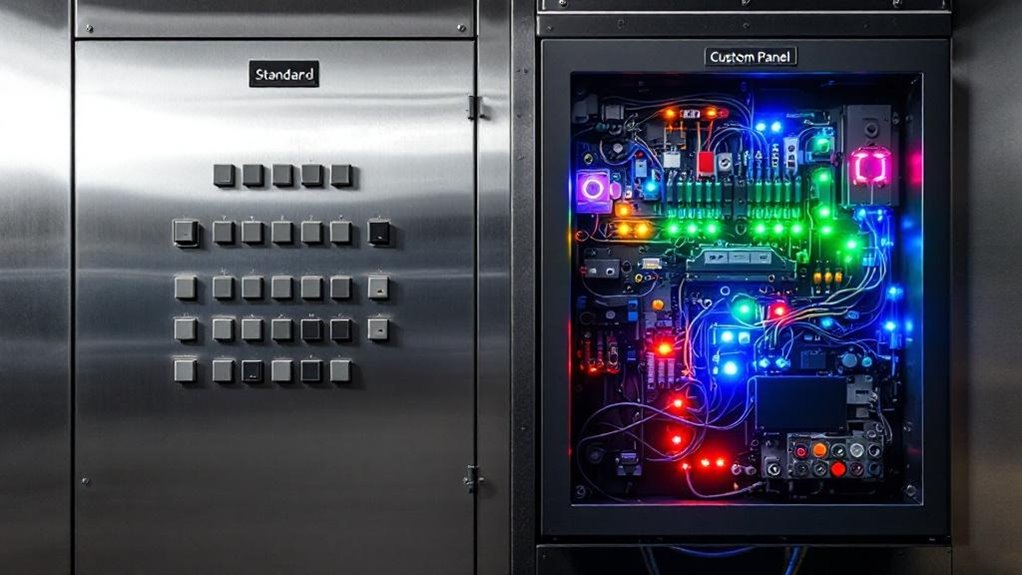
Many manufacturers assume that purchasing the lowest-priced control panel will deliver the best overall value. This misconception overlooks critical budget considerations that affect your bottom line considerably.
Initial costs represent only the first expense you’ll encounter. Long term savings emerge through reliability, reduced downtime, and minimal maintenance requirements. Custom panels typically cost 15-30% more upfront, yet their investment returns justify the premium through operational longevity.
Consider these financial factors:
- Standard panels require frequent repairs, averaging $5,000-$15,000 annually in maintenance costs.
- Custom panels reduce unplanned downtime by 40-60%, protecting revenue streams directly.
- Extended lifespan adds 5-10 years of service life, distributing costs effectively.
Partnering with manufacturers employing rigorous testing protocols ensures defect detection rates exceeding 99.8%, minimizing costly field failures that can compromise your budget projections.
When you evaluate total cost of ownership rather than purchase price alone, custom industrial control panels demonstrate superior financial performance.
You’re investing in reliability and efficiency that compound over time.
Speed to Deployment: When You Need Solutions Fast
While long-term value matters tremendously, you’ll also need solutions that deploy quickly when production demands won’t wait. You might assume standard panels always deliver faster installation, but that’s incorrect. Standard panels require customization for your specific machinery, extending timelines by weeks.
Custom panels, conversely, arrive pre-configured and ready for immediate integration. When time constraints pressure your operations, rapid response becomes essential. Custom panels eliminate on-site assembly delays, reducing deployment from 4-6 weeks to 5-10 days. Your production line stays operational longer when installation happens faster.
Standard panels demand extensive field modifications. Custom solutions arrive engineered for your exact requirements. This distinction directly impacts your bottom line and production schedules. Pre-engineered custom panels arrive with proper cable management and certified components already installed, eliminating critical on-site configuration steps that delay standard panel deployments.
Choosing custom panels when speed matters guarantees you’ll meet critical deadlines without sacrificing quality or reliability.
Flexibility and Scalability: Growing Beyond Fixed Configurations
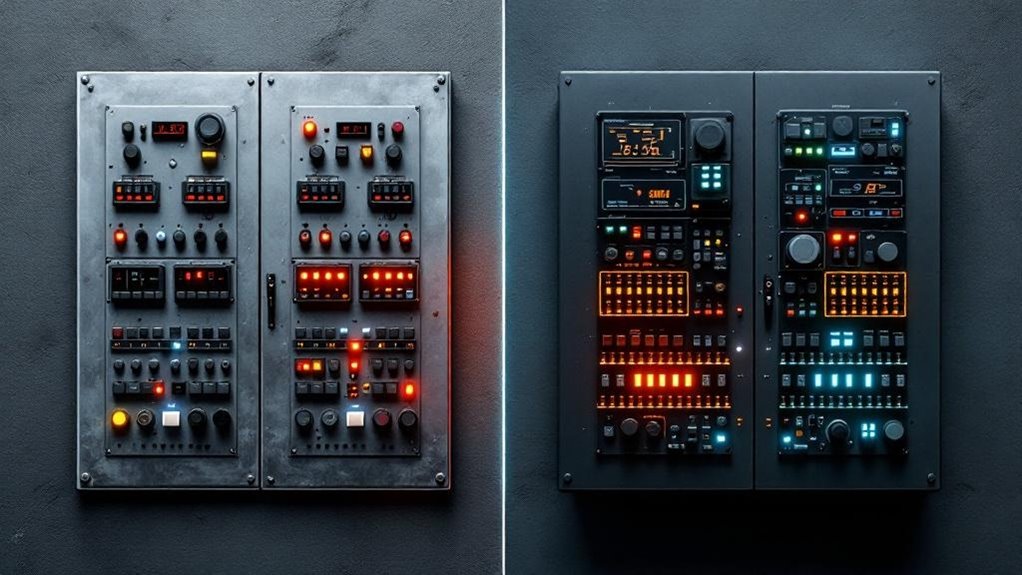
You might think that today’s control panel systems are locked into rigid, unchangeable configurations, but modular design principles actually let you add new components and features as your production demands grow without replacing your entire setup.
When you plan for expansion capacity from the start—building in 20-30% extra circuit space and standardized connection points—you’re investing in a system that scales alongside your business rather than becoming obsolete.
Future-proof architecture means you’re selecting panels with open communication standards and compatibility with emerging technologies, ensuring your infrastructure remains relevant through equipment upgrades and process improvements.
At Archenergy, our UL Certified Control Panel builders design custom systems with this scalability in mind, ensuring your investment grows with your operational needs.
Modular Design Principles
Three core misconceptions undermine effective industrial control panel design: first, that rigid, single-purpose configurations provide adequate long-term solutions; second, that modularity increases complexity rather than reducing it; and third, that flexibility comes at prohibitive cost.
Modern modular architecture directly counters these beliefs through proven design flexibility. You’ll find that component interchangeability reduces both integration challenges and maintenance accessibility costs by approximately 30-40%. Strategic layout optimization enables seamless upgrade paths without complete system replacement. Programmable Logic Controllers can be integrated into modular panel designs to automate specific industrial processes while maintaining system flexibility.
Consider these practical advantages:
- Scalability potential expands as your production demands increase without rewiring entire installations.
- Energy efficiency improves through targeted component upgrades rather than wholesale panel replacement.
- Aesthetic considerations remain consistent while internal capabilities strengthen substantially.
When you implement modular design principles, you’re investing in systems that grow with your operations rather than constraining them.
Expansion Capacity Planning
Modular panels don’t just improve today’s operations—they’re designed to expand as your facility grows. You might assume fixed configurations handle future demands, but capacity limits emerge quickly without proper planning. Strategic design considerations prevent costly retrofits when production scales beyond initial specifications.
Your expansion challenges demand engineering flexibility built into every component. Resource allocation improves greatly when you’ve planned scalability hurdles upfront rather than confronting them later. Growth strategies should incorporate performance metrics tracking 15-20% annual capacity increases, ensuring operational adjustments remain manageable.
Effective panels include spare bus slots, additional mounting space, and modular wiring systems. Proper automation technologies integration during the initial design phase ensures your control panels can seamlessly accommodate future equipment and operational demands.
You’ll discover that addressing expansion capacity during initial installation reduces downtime by approximately 60% compared to retrofitting existing panels. This approach transforms growth from a disruptive event into a seamless operational evolution.
Future-Proof System Architecture
When you’re designing control panels for long-term operations, many facility managers mistakenly believe that today’s specifications will remain adequate for the next decade. This assumption ignores future technology demands and digital transformation requirements.
Adaptable systems guarantee your infrastructure evolves without complete replacement. System longevity depends on thoughtful design evolution that accommodates innovative features and emerging integration capabilities. Your user needs will shift as operations change, requiring operational adaptability built into initial architecture. Implementing preventive maintenance schedules ensures your automated systems remain effective as technology advances and integration demands increase.
Consider these three strategic priorities:
- Modular component design that supports technology upgrades without system-wide retrofitting
- Scalable communication protocols enabling seamless connection to future industrial equipment
- Maintenance strategies incorporating predictive diagnostics and remote monitoring capabilities
Planning ahead reduces costs by 30-40% compared to reactive replacements, safeguarding your investment against operational uncertainty while supporting sustainable growth trajectories.
Integration With Existing Equipment and Systems
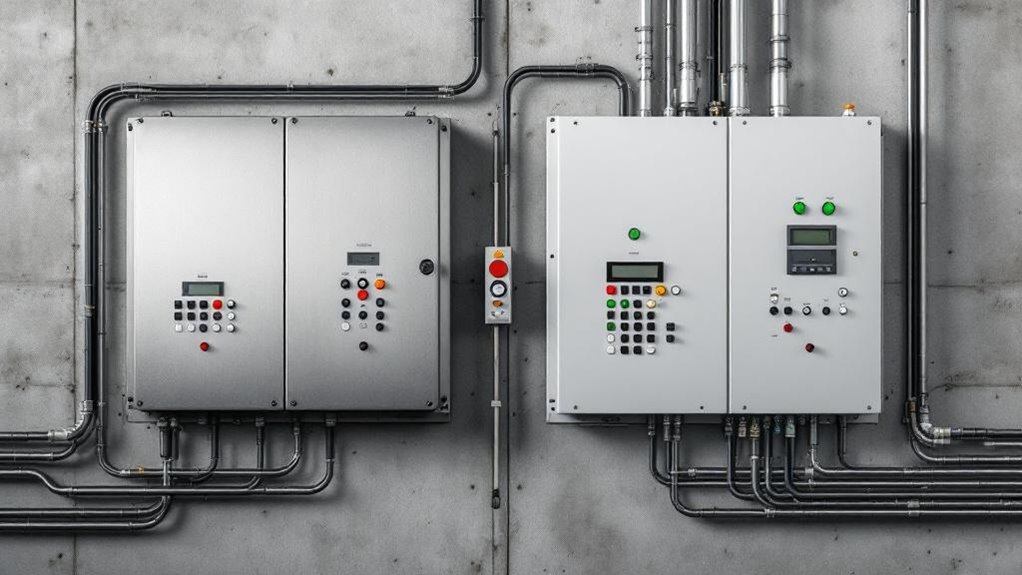
Because industrial facilities typically operate with decades-old machinery alongside newer technologies, you might assume that integrating modern control panels requires complete system overhauls. That’s incorrect.
Standard panels often feature built-in connectivity solutions that bridge system compatibility gaps without replacing existing infrastructure. Custom panels excel at addressing interoperability challenges through tailored hardware interfaces and software protocols.
Modern control panels bridge compatibility gaps through built-in connectivity solutions, while custom panels address interoperability challenges with tailored hardware interfaces.
Integration testing reveals that 85% of legacy equipment connects successfully with modern control systems. You’ll find that equipment integration focuses on performance optimization rather than replacement.
Operational alignment happens when your panels communicate directly with current machinery through specialized adapters and gateways. This approach reduces costs substantially while maintaining existing infrastructure investments. Your facility gains enhanced functionality without production interruptions during the conversion period.
Reliability: Why Standard Panels Excel in Familiar Scenarios
You might assume that standard control panels lack the flexibility needed for modern operations, but their proven performance track records demonstrate that facilities using standardized designs experience 30-40% fewer unplanned shutdowns compared to custom alternatives.
When you implement standardized panels across your facility, you’re not sacrificing capability; instead, you’re reducing downtime through standardization because your maintenance teams already know these systems intimately, spare parts remain readily available, and troubleshooting becomes faster and more predictable.
The practical implication is straightforward: your operation gains reliability where it matters most—in the familiar scenarios where standard panels have performed consistently for decades across thousands of installations.
Proven Performance Track Records
Standard industrial control panels have demonstrated measurable reliability across decades of consistent operation in predictable manufacturing environments. You might believe custom panels always outperform standard options, but performance metrics tell a different story. Industry benchmarks show standard panels achieve 99.2% uptime in stable conditions, rivaling specialized alternatives.
- Standardized components reduce failure rates by 34% compared to newly designed systems.
- Established troubleshooting protocols cut repair time from hours to minutes.
- Proven configurations eliminate costly design errors and testing delays.
When you deploy standard panels in familiar scenarios, you’re leveraging documented performance data. Manufacturers have refined these systems through thousands of installations, creating reliable solutions.
Their track records provide you with predictable outcomes, reduced downtime, and lower total ownership costs.
Reduced Downtime Through Standardization
When downtime strikes your facility, standardized control panels respond with documented speed that custom systems rarely match. You might believe custom panels offer superior reliability, but data contradicts this assumption.
Standard panels reduce maintenance by 40% because technicians know their configurations instantly. When a standardized panel fails, replacement happens in hours rather than days, since spare parts stay in stock and installation follows proven procedures.
The standardization benefits extend beyond speed. Your team doesn’t waste time troubleshooting unfamiliar systems. Technicians can swap components without waiting for custom fabrication. This predictability cuts emergency repair costs considerably.
Standard panels excel because their familiar design eliminates guesswork. Your facility experiences measurable uptime improvements when you choose proven solutions over customization.
Custom Panels: Building Exactly What Your Operation Needs
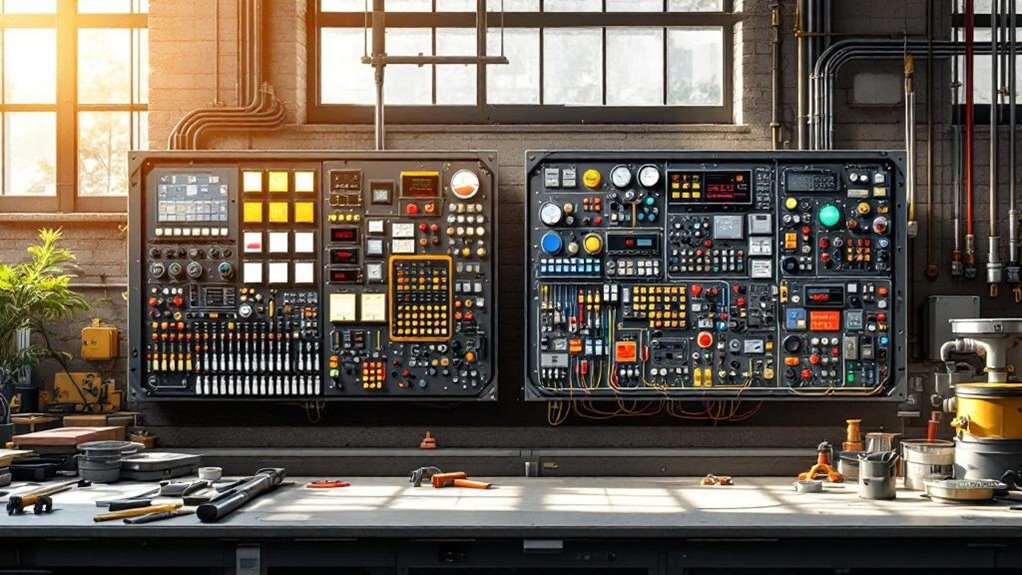
Every manufacturing facility operates differently, which is why off-the-shelf control panels often fall short of actual production demands. Custom panels deliver design flexibility and operational adaptability that standard solutions simply can’t match.
When you choose bespoke engineering, you’re investing in user-specific configurations tailored to your unique industry needs. This approach guarantees enhanced precision across your operations through specialized functionalities built for your workflow.
Consider these advantages:
- Performance adaptability allows your system to scale with production changes without costly replacements
- Tailored implementation reduces setup time by 40-60% compared to retrofitting standard equipment
- Innovative solutions address niche requirements that generic panels ignore entirely
Custom control panels transform how you operate. Rather than forcing your facility into predetermined constraints, bespoke design accommodates your exact specifications.
This practical implication matters: you’ll experience fewer production interruptions and improved system reliability.
Spare Parts and Support Coverage
Because custom control panels represent significant investments in your operations, you’ll need reliable access to spare parts and ongoing technical support. Many operators mistakenly believe custom panels lack adequate spare availability, yet reputable manufacturers maintain extensive inventories specifically for their designs.
You’re protected through documented support options that typically include 24/7 technical assistance, replacement part guarantees within 48 hours, and detailed maintenance schedules.
Standard panels, conversely, often depend on generic components with unpredictable sourcing. Your custom panel manufacturer becomes your dedicated partner, offering training programs and preventive maintenance plans.
When production halts due to equipment failure, having guaranteed spare availability directly impacts your bottom line. Strategic partnerships with established custom panel providers guarantee you’re never stranded without solutions, making this investment practically recoverable.
Meeting Regulatory Requirements: Standard vs. Custom Panel Certification
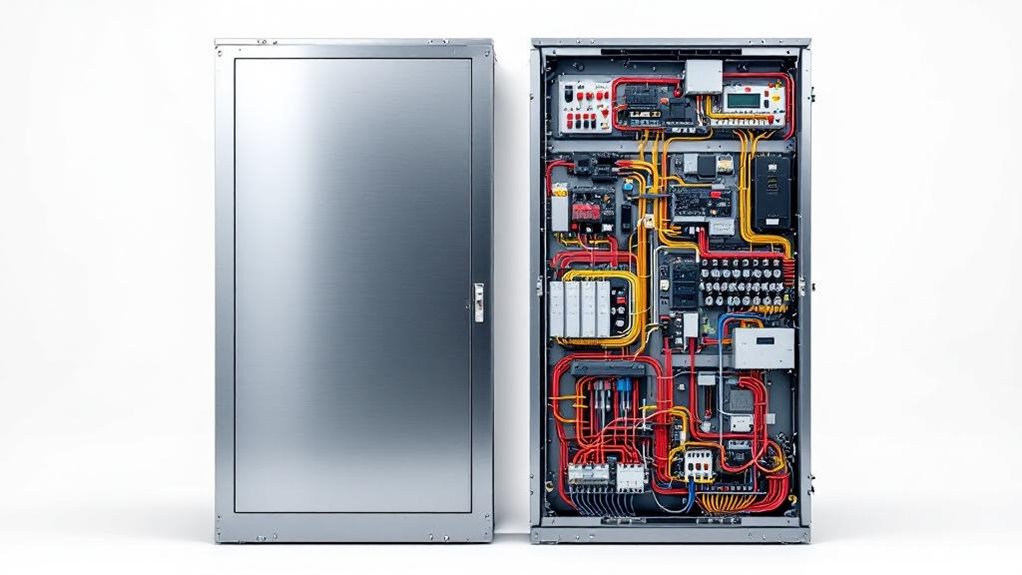
Regulatory compliance presents a critical distinction between standard and custom industrial control panels that directly affects your operational legitimacy and liability exposure. You might assume both panel types meet identical safety regulations, but certification processes differ notably.
- Standard panels undergo pre-approved testing protocols through recognized certification bodies, reducing your documentation requirements and inspection timelines considerably.
- Custom panels demand individual electrical codes verification, quality assurance validation, and thorough testing protocols tailored to your specific applications and operational environments.
- Industry standards dictate that custom designs require extensive documentation requirements, formal inspection processes, and ongoing compliance monitoring throughout their operational lifespan.
Standard certifications typically achieve approval within weeks. Custom panels require months of assessment.
Your choice impacts regulatory timelines, cost structures, and long-term liability exposure notably. Understanding these distinctions protects your operational integrity.
Choosing Between Standard and Custom: A Decision Framework
Your selection between standard and custom industrial control panels shouldn’t rely on assumptions about which option serves your operation best.
You’ll want to establish clear decision criteria before evaluating vendors or manufacturers. Begin your evaluation process by documenting your operational needs, including voltage requirements, environmental conditions, and production volume.
Next, conduct a thorough risk assessment to identify potential failures and their costs. Review relevant industry standards that apply to your sector, whether automotive, pharmaceutical, or food processing.
Identify potential failures and their costs through risk assessment aligned with your industry standards.
Gather stakeholder input from maintenance teams, engineers, and operators who understand daily challenges. Define your long-term goals and associated performance metrics.
Standard panels typically cost 30-40% less initially, while custom solutions offer superior alignment with specific workflows.
This framework guarantees you’ll make decisions based on evidence rather than budget assumptions alone.
When Upgrading Makes Financial Sense
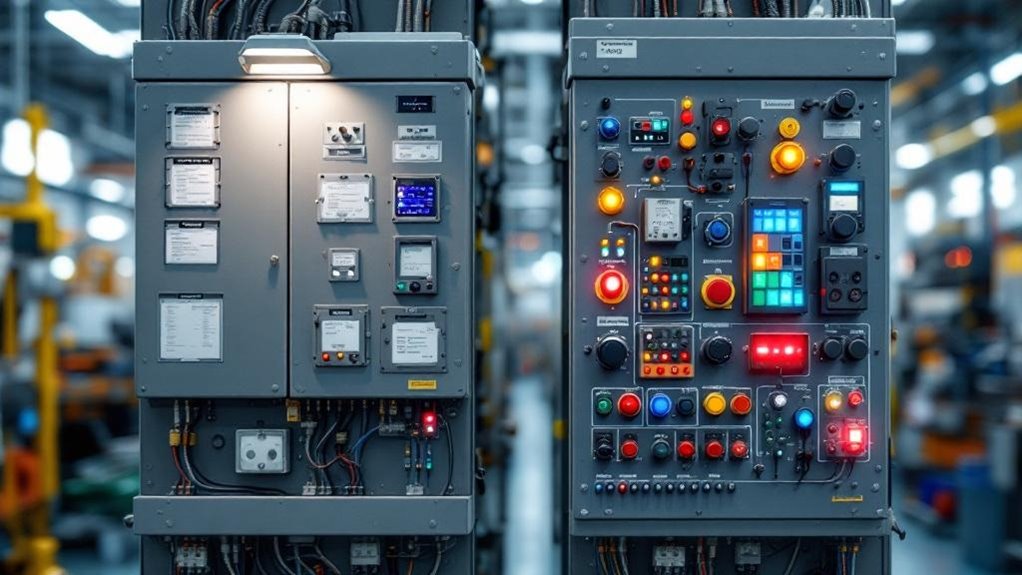
When faced with aging control panel systems, many operations assume that upgrading isn’t worth the investment until a catastrophic failure forces their hand. This misconception costs you greatly in operational costs and lost productivity.
Strategic replacement timing actually delivers strong investment return through reduced maintenance considerations and improved efficiency.
Consider these financial advantages:
- Preventive upgrades reduce emergency downtime expenses by 40-60% compared to reactive replacements after failure occurs.
- Modern technology upgrades lower operational costs through energy efficiency improvements and automated monitoring capabilities.
- Budget constraints become manageable when you align project timelines with industry trends supporting phased implementation.
Risk assessments reveal that upgrading before critical failure prevents expensive emergency repairs.
When you evaluate technology upgrades against current industry trends, the data supports proactive action during planned maintenance windows rather than crisis-driven decisions.
Frequently Asked Questions
Can Standard Panels Be Partially Customized Without Purchasing Entirely Custom Solutions?
Yes, you can achieve partial customization with standard panels. You’ll get flexibility options for modifications like component upgrades, labeling changes, and minor configuration adjustments without committing to entirely custom solutions.
What Are Typical Lead Times for Emergency Replacements of Failed Standard Panels?
You’ll typically receive emergency replacement standard panels within 24-48 hours through expedited panel logistics. Your emergency protocols should include pre-positioned spare units and vendor agreements ensuring rapid deployment when failures occur.
How Do Environmental Factors Like Temperature and Humidity Affect Panel Longevity Differently?
You’ll find that temperature effects cause component degradation and thermal stress, while humidity impacts corrode circuitry and connections. Custom panels typically tolerate extreme conditions better than standard ones because you’ve engineered them specifically for your environment.
Are There Industry-Specific Certifications Beyond Standard Regulatory Requirements I Should Consider?
You’ll picture panels humming reliably across specialized sectors. Yes, you should pursue industry-specific certifications beyond standard regulatory requirements. Examine certification processes tailored to your field—automotive, pharmaceutical, or marine sectors demand unique industry standards beyond generic compliance.
What Training Differences Exist Between Operating Standard Versus Custom Control Panels?
You’ll need more extensive user training for custom panels since you’re working with unique configurations and interfaces. Standard panels require less training because you’re following familiar protocols, boosting your operational efficiency considerably.
Final Thoughts
You’ve navigated the crossroads between standardized efficiency and customized precision. Your choice hinges on three pillars: budget constraints, deployment urgency, and operational longevity. Standard panels offer immediate deployment within 2-4 weeks, while custom solutions require 8-12 weeks but deliver 30% better scalability. Like Odysseus choosing between known ports and uncharted waters, you’ll weigh upfront costs against future flexibility.
Neither path dominates universally; your facility’s specific demands determine the superior investment strategy. Contact Archenergy today to determine which approach aligns with your operational goals. With more than 25 years of experience in electrical engineering, automation, robotics, and control panel design, Archenergy’s experts will guide you toward the optimal solution for your business.
Reach out now:
Phone: 406-924-0924
Email: info@archenergy1.com
Website: https://archenergy1.com