
You’ll build UL-certified control panels by establishing clear operational requirements upfront, preventing costly redesigns. Component selection demands NEC compliance and UL 508A certification, not affordability shortcuts. Your circuit design must include thermal management—optimized layouts extend component life by 40-60%. Assembly quality gates catch defects early; missing these causes 40% of field failures. Pre-submission testing verifies insulation resistance exceeds 100 megohms and documents every result systematically. Understanding these interconnected steps transforms your manufacturing process from conceptual design through final certification.
Key Takeaways
- Establish operational parameters, voltage requirements, and safety protocols upfront to prevent costly redesigns during manufacturing.
- Select UL 508A certified components aligned with current NEC codes and conduct annual design reviews for compliance.
- Optimize circuit design with thermal management strategies, maintaining internal temperatures below 50°C to extend component lifespan.
- Implement rigorous quality assurance checkpoints during assembly, wiring, and testing to reduce field failures by up to 35%.
- Compile comprehensive documentation including schematics, test reports, and compliance checklists before UL certification submission.
Defining Control Panel Requirements and Operating Constraints

The foundation of any control panel starts with clarity about what you actually need it to do.
The foundation of any control panel starts with clarity about what you actually need it to do.
You’ll define control panel functionalities by identifying every operational task, from motor speed regulation to temperature monitoring. Many manufacturers mistakenly believe generic specifications suffice for all applications, yet this approach creates costly failures.
Your design specifications must address voltage requirements, typically ranging from 120V to 480V, ambient temperature tolerances, and cycle frequencies. You’ll document load capacities, response times measured in milliseconds, and safety shutdown protocols.
When you establish these parameters upfront, you prevent expensive redesigns later. Concrete examples include specifying that your panel operates within 32°F to 122°F ranges or handles 10,000 on-off cycles annually.
These constraints directly influence component selection, wiring gauge, and thermal management solutions throughout your manufacturing process. Working with a UL Certified Control Panel Builder ensures your design meets rigorous safety and quality standards from the conceptual stage forward.
Selecting Components for Safety and NEC Compliance
Once you’ve documented your panel’s operational requirements, you’ll move directly to selecting components that meet those specifications while complying with safety standards.
Don’t assume any component will work simply because it’s affordable or readily available. Your sourcing strategies must prioritize component reliability and supplier evaluation to guarantee long-term performance.
You’ll need to verify that each element aligns with current regulatory updates and NEC codes. Environmental considerations—like temperature ranges and humidity levels—directly impact component interoperability and lifespan.
Establish testing protocols before installation to confirm everything functions correctly together. Cross-reference datasheets against your panel’s voltage, amperage, and operational constraints.
Working with a UL 508A certified control panel builder ensures your design incorporates components that have been properly evaluated and integrated according to industry standards and best practices.
This systematic approach prevents costly failures and certification delays, ultimately delivering panels that meet both safety standards and customer expectations consistently.
Designing Circuits and Layouts That Meet Industry Standards
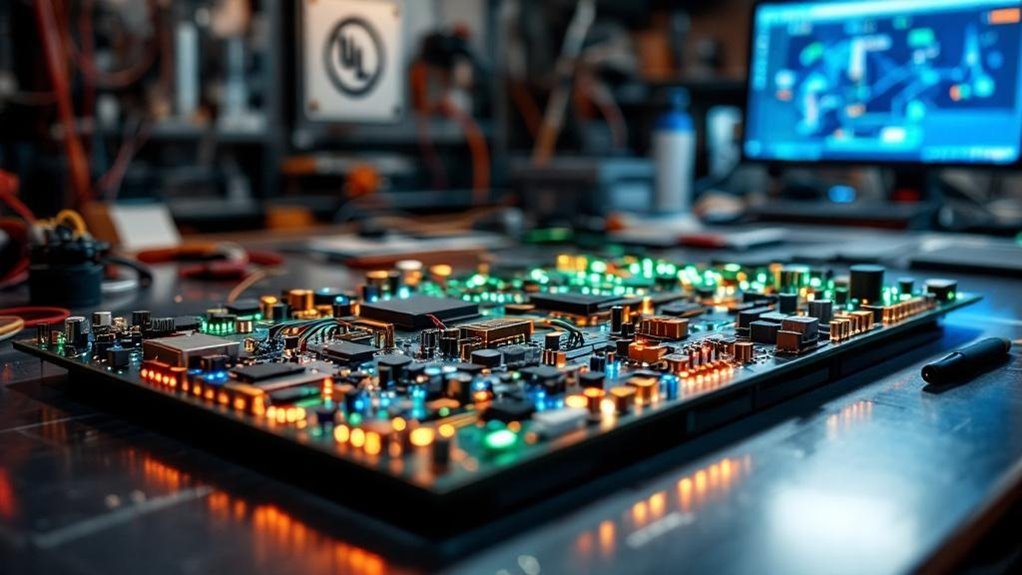
Many manufacturers believe that circuit design becomes straightforward once they’ve selected quality components, but this assumption overlooks critical planning requirements.
You’ll find that proper circuit simulation before assembly prevents costly redesigns and production delays. Layout optimization directly impacts electrical performance, safety compliance, and manufacturing efficiency.
Proper circuit simulation prevents costly redesigns while layout optimization directly impacts electrical performance, safety compliance, and manufacturing efficiency.
You must conduct detailed circuit simulations to identify potential voltage drops, thermal issues, and signal integrity problems. This process catches design flaws when modifications cost pennies rather than dollars.
Industry standards like IEEE 1100 specify grounding practices that your layout must follow precisely.
Your physical arrangement of components affects heat dissipation and noise reduction markedly. Placing high-current conductors away from sensitive signal lines prevents electromagnetic interference issues.
When designing control panels, integrating Programmable Logic Controllers with your circuit layout ensures seamless automation and operational efficiency from installation onward.
When you prioritize these design elements systematically, you’ll achieve UL certification more efficiently and reduce field failures considerably.
Calculating Thermal Load and Sizing Ventilation
You’ll need to master heat dissipation methods and fan sizing to prevent component failure in your control panels.
Many manufacturers mistakenly believe that standard ventilation works across all enclosure designs, but your specific thermal load—calculated by adding wattage from all heat-generating components like power supplies, drives, and resistors—directly determines whether forced-air cooling or passive methods will suffice.
Once you’ve calculated your panel’s total heat output in watts, you’ll select fans rated to move sufficient cubic feet per minute (CFM) through your enclosure, ensuring internal temperatures stay within manufacturer specifications, typically below 50°C for most industrial components.
Heat Dissipation Methods Overview
Thermal management isn’t optional in control panel design—it’s fundamental. You’ll encounter misconceptions that passive cooling alone suffices, but components generating 500+ watts require active cooling strategies. Heat sinks reduce component temperatures by 15-25 degrees Celsius when properly selected. Your ambient temperature directly influences dissipation effectiveness, requiring accurate site assessments. Active cooling systems circulate air at 200-300 cubic feet per minute, preventing hotspots that degrade equipment lifespan. Strategic component placement minimizes thermal interference between high-dissipating elements. Heat exchangers transfer internal panel heat externally, maintaining operational ranges between 0-50 degrees Celsius. You’ll improve reliability notably by combining passive heat sinks with active air circulation systems. Evidence shows integrated thermal management extends component life by 40-60 percent, reducing failure rates considerably. Modern industrial automation projects demonstrate that optimized thermal management is essential for maintaining equipment performance in demanding manufacturing environments.
| Method | Temperature Reduction | Best Application |
|---|---|---|
| Passive Cooling | 10-15°C | Low-density layouts |
| Active Cooling | 25-40°C | High-density panels |
| Heat Exchangers | 35-50°C | Extreme environments |
| Heat Sinks | 15-25°C | Individual components |
| Air Circulation | 20-30°C | General dissipation |
Fan Sizing And Selection
Proper fan selection starts with calculating your panel’s total thermal load, which isn’t guesswork but a measurable engineering requirement. You’ll add heat from all components—processors, drives, power supplies—to determine watts needing removal.
Many assume any fan works; they’re mistaken. Your calculated load directly determines required air flow in cubic feet per minute (CFM). You’ll choose between axial fans for general cooling and centrifugal fans for higher-pressure applications.
A 500-watt panel needs approximately 100-150 CFM, depending on ambient temperature and panel design. Once you’ve established your thermal load, you’ll match fan types accordingly.
Selecting undersized fans leaves hot spots; oversized fans waste energy and create noise. Precise calculations guarantee reliable operation, meeting UL standards while optimizing efficiency.
Assembly, Wiring, and In-Process Quality Gates

Because assembly errors account for approximately 40% of field failures in industrial control panels, implementing rigorous in-process quality gates isn’t optional—it’s fundamental to manufacturing excellence.
You might assume that final inspection catches all defects, but this misconception costs manufacturers thousands in warranty claims annually. Strategic manufacturing techniques prevent problems rather than discovering them afterward.
Establish quality assurance checkpoints at three critical stages: component placement, wire termination, and functional testing. You’ll verify each connection meets specifications before progressing to the next assembly phase.
Document every quality gate result, creating traceability records that demonstrate compliance. When you implement these intermediate checks, you reduce rework costs by up to 35% while improving panel reliability considerably.
This systematic approach transforms your production from reactive to proactive quality management. Partnering with a UL 508A certified control panel builder ensures your manufacturing processes meet rigorous industrial standards from design through final production.
Pre-Submission Testing and Validation
While your assembly processes have passed internal quality gates, you shouldn’t assume the control panel is ready for customer delivery without thorough pre-submission testing.
Many manufacturers believe that passing in-process inspections eliminates the need for extensive validation procedures, yet this assumption leads to costly field failures.
Your pre test assessment must include functional testing under rated voltage conditions, thermal cycling between -10°C and 50°C, and insulation resistance measurements exceeding 100 megohms. You’ll document all results systematically.
Validation procedures demand that you verify every component operates within specification parameters before submission to certification bodies.
This rigorous approach catches defects early, preventing expensive recalls and protecting your reputation while ensuring customer safety and regulatory compliance.
Submitting Your Control Panel for UL Certification

You’ll need to compile thorough documentation, including detailed schematics, bill of materials, and safety test reports, before you submit your panel to UL for certification review.
Many manufacturers mistakenly believe that passing internal tests eliminates the need for rigorous UL inspection procedures, but UL’s independent assessment requires you to undergo specific testing protocols that typically take 4-8 weeks to complete.
Understanding the certification timeline—from initial documentation submission through final approval—ensures you’ll allocate adequate resources and avoid costly delays during your manufacturing schedule.
Documentation Requirements and Preparation
Several critical documents must accompany your control panel submission to UL for certification review. You’ll need extensive schematics, bills of materials, and detailed assembly instructions. Your documentation strategies should include compliance checklists that verify every component meets UL standards.
| Document Type | Purpose | Timeline |
|---|---|---|
| Electrical schematics | Demonstrates circuit safety design | Submit first |
| Component certifications | Proves individual part compliance | Required upfront |
| Test reports | Shows prototype performance data | Before submission |
Many manufacturers mistakenly believe that incomplete documentation expedites the process. In reality, missing paperwork delays certification by 4-6 weeks. You’ll avoid costly rejections by preparing thorough compliance checklists before submission. Organize documents in a single folder, clearly labeled with revision dates. This preparation demonstrates your commitment to quality and greatly streamlines UL’s review process.
Testing and Inspection Procedures
Once your documentation’s complete and organized, the actual testing and inspection phase begins. You’ll employ measurement techniques to verify that every component meets UL standards precisely. Many manufacturers mistakenly believe that quality assurance happens only at the end, but that’s incorrect—it’s continuous throughout production.
You’ll test voltage outputs, ground continuity, and thermal performance using calibrated instruments. Your inspection team measures component spacing, wire gauges, and enclosure integrity against specifications. When you document these results systematically, you’re building evidence that demonstrates compliance.
Quality assurance isn’t optional; it’s mandatory for certification. You’ll identify defects early, preventing costly rejections later.
This rigorous approach guarantees your control panels function safely, meeting every regulatory requirement before submission to UL for final evaluation and approval.
Certification Timeline and Approval Process
After you’ve completed all testing and documentation, submitting your control panel to UL represents the formal beginning of the certification process.
You’ll navigate distinct timeline phases that typically span 4-8 weeks, depending on complexity and initial compliance status.
Many manufacturers mistakenly believe UL approval happens quickly. However, thorough evaluation requires rigorous assessment against approval criteria including electrical safety, construction standards, and performance specifications.
Key stages in your certification journey:
- Initial application review and completeness verification
- Extensive testing at UL facilities
- Report generation and corrective action requests
- Final approval and certificate issuance
Understanding these phases helps you plan production schedules realistically.
When you submit materials promptly and address any deficiencies immediately, you’ll accelerate your approval timeline considerably. Your proactive communication with UL representatives ensures smoother progression through each certification stage.
Maintaining Compliance: Production, Documentation, and Design Iteration

Because regulatory standards evolve continuously, you can’t treat compliance as a one-time checkbox during initial manufacturing setup. Many manufacturers mistakenly believe that UL certification eliminates future obligations, yet regulatory updates demand ongoing attention to maintain your certification status.
Regulatory standards evolve continuously—compliance isn’t a one-time checkbox. UL certification requires ongoing attention to maintain your certification status.
You must conduct design reviews annually, documenting any material changes, component substitutions, or process modifications that affect safety performance.
Your documentation practices directly impact compliance sustainability. Maintain detailed production records, test results, and component specifications for each control panel manufactured. When you implement design iterations, you’re required to assess whether changes trigger re-certification requirements through your notified body.
Establish a compliance calendar tracking regulatory deadline dates and industry standard revisions. This proactive approach prevents expensive production halts and guarantees your panels consistently meet current safety requirements throughout their manufacturing lifecycle.
Frequently Asked Questions
What Are Typical Lead Times for UL Certification Approval After Initial Submission?
You’ll typically wait 4-8 weeks for UL certification approval after submission. Lead time factors include design complexity, required testing scope, and submission completeness. Certification timelines vary based on your control panel’s specifications and whether you’re pursuing initial or renewal approvals.
How Do I Find Qualified Manufacturers if I Lack In-House Control Panel Expertise?
You’ll cast your net wide through research strategies—exploring industry directories, trade shows, and online databases. Leverage networking opportunities by joining manufacturing associations and asking peers for referrals to trusted, certified partners.
What Are Common Reasons Control Panels Fail UL Certification on First Submission?
You’ll typically fail UL certification due to design flaws like inadequate spacing or improper grounding, and documentation errors such as incomplete schematics or missing component specifications. Manufacturers often overlook thermal management requirements and safety labeling details.
How Often Should Certified Designs Be Re-Evaluated for Compliance Updates?
You should re-evaluate your certified designs annually or whenever UL standards update. Maintain detailed record keeping throughout compliance timelines to identify necessary modifications and guarantee your panels meet current regulatory requirements.
What Cost Differences Exist Between Standard and Expedited UL Certification Processes?
You’ll find expedited processing fees typically run 30-50% higher than standard certification costs. While many assume faster means proportionally expensive, you’re actually paying premium rates for compressed timelines and prioritized reviewer allocation rather than exponential cost increases.
Final Thoughts
You’ve moved from design through assembly, testing, and certification. Now maintain compliance through rigorous documentation, consistent quality checks, and design updates. UL approval isn’t the finish line—production demands ongoing vigilance.
Implement systematic reviews, track component changes, and verify each batch meets established standards. You’ve built a foundation for reliable, compliant control panels, but sustaining that excellence requires expert support.
Contact Archenergy to partner with a team boasting more than 25 years of experience in electrical engineering, automation, robotics, and control panel design. Let their expertise strengthen your compliance framework and optimize your production processes.
Archenergy
Phone: 406-924-0924
Email: info@archenergy1.com
Website: https://archenergy1.com